Skip to content

2026

When DeFi Stops Being DeFi

Permissioned tokens, RWAs, and the boundary where the cyber premise meets the law

Part 1 built the vault as DeFi's cornerstone; Part 2 walked the three challenges that arise when the asset behaves differently. All of that stayed inside DeFi's founding premise: permissionless, trustless, censorship-resistant — anyone can hold, anyone can transact, no one can freeze you. This post is about the axis where that premise doesn't just bend, it breaks. Real-world assets carry the law of a jurisdiction, and law has to be enforced. Permissioned tokens are where DeFi rails meet TradFi rules — and standing on that bridge, you are in neither world purely.


0. A different kind of axis

Parts 1 and 2 varied the shape of the claim — what it's worth (pricePerShare), when you can redeem it (sync vs ERC-7540 async), how its payoff resolves (ERC-1155 conditional tokens). Every one of those questions lives inside the permissionless model. You never had to ask who was allowed to hold the token, because the answer was always anyone.

Permissioning is a perpendicular question: not what the claim is, but who is legally allowed to hold or move it. It doesn't replace any standard from Parts 1–2 — it layers on top of them. And it's the one axis that puts you outside the cypherpunk premise entirely, because the reason it exists is external to the chain.


1. The collision: the physical world has laws

DeFi's origin story is adversarial to gatekeepers. A vault share, a stablecoin, an LP token — they're bearer instruments: hold the key, hold the asset, move it to anyone, and no issuer can stop you. That's the whole point. "Code is law" means the contract's logic is the only rule, and the contract doesn't care who you are.

A real-world asset does not get to make that choice. A tokenized US Treasury bill, a corporate bond, a real-estate share — the underlying exists inside a jurisdiction, and that jurisdiction comes with securities law, KYC/AML, sanctions screening, tax reporting, and courts. You cannot tokenize a regulated security and wish those away; the legal reality travels with the asset onto the chain.

And here's the crux: those laws have to be enforceable. A regulator or a court doesn't accept "the smart contract is immutable, sorry." If a holder is sanctioned, their tokens must be freezable. If a court orders restitution, the tokens must be moveable without the holder's key. Off-chain paperwork can't enforce that on a bearer token that anyone can move in one block — so the enforcement has to be pushed into the token itself.

That is the collision. Code-is-law meets law-is-law, and law-is-law wins — because the asset's value depends on the legal system recognizing it. The moment you accept that, you've left permissionless DeFi.


2. Importing enforcement into the token

To satisfy the law, a permissioned token has to do three things a normal ERC-20 never does:

  1. Gate who can hold it — an on-chain identity / allowlist. Only verified (KYC'd, accredited, non-sanctioned) wallets may receive tokens. A transfer to a non-whitelisted address simply reverts.
  2. Gate how it moves — programmable compliance: holding-period lockups, per-country caps, max-holder counts, qualified-purchaser rules. canTransfer(from, to, amount) must return true before any transfer settles.
  3. Override the holder — and this is the sharpest break. A designated transfer agent / issuer can freeze a balance or force-transfer it to another address without the holder's consent, to obey a court order, a sanctions list, or a recovery request.

That third power is the clean inversion of everything DeFi promised. Censorship-resistance means no one can freeze or seize your assets. A permissioned RWA token ships with a function whose entire job is to let someone do exactly that. It's not a bug or a backdoor — it's a legal requirement, deliberately built in. But it means the token is only as trustless as the entity holding the controller key.
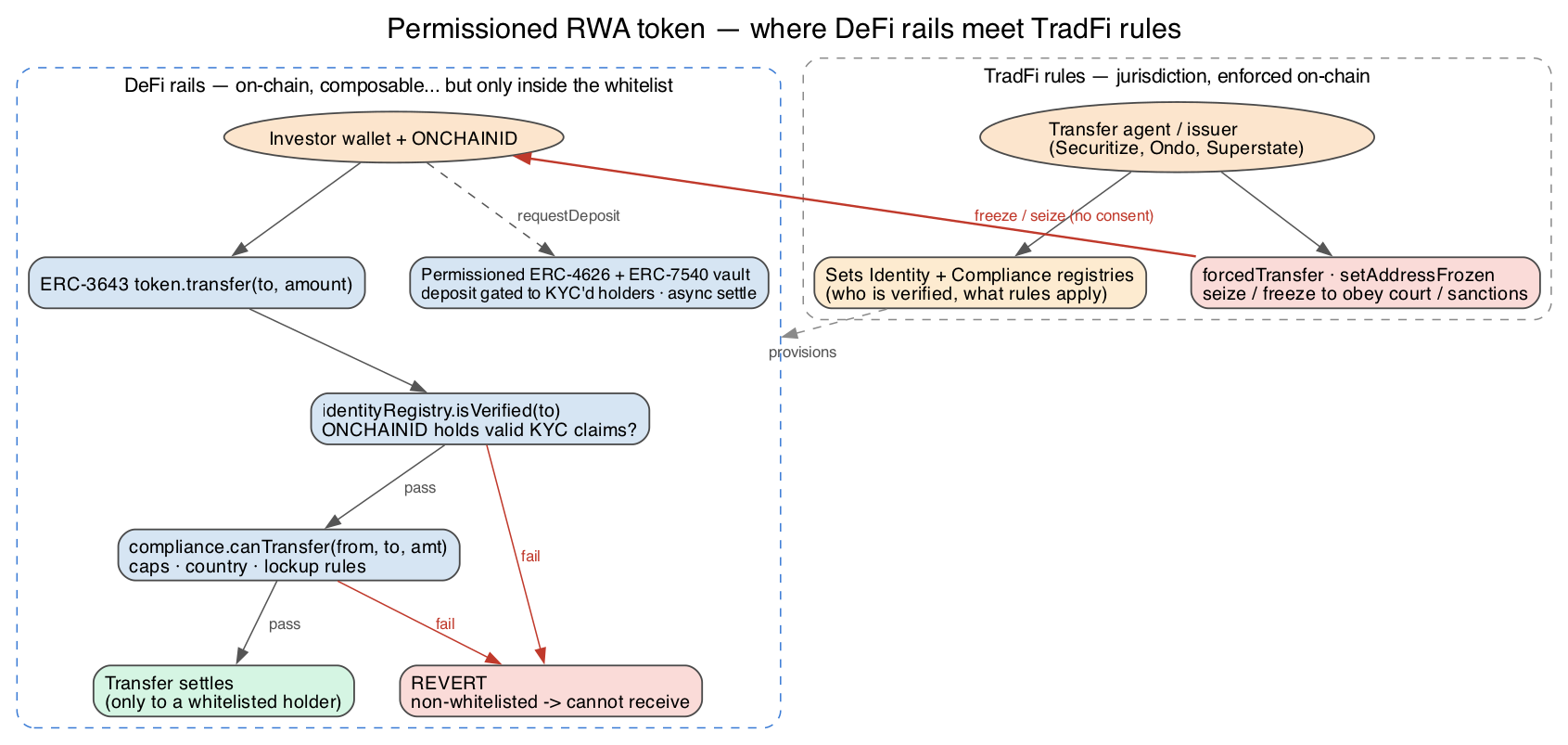
Permissioned RWA token — DeFi rails meet TradFi rules


3. The standards that encode it

Three standards (one dominant, two older cousins) express this on-chain.

ERC-3643 (T-REX) — the dominant one

ERC-3643 reached Final status in December 2023 — the first compliance-token standard to do so — and is maintained by Tokeny and the nonprofit ERC-3643 Association. It's a suite of six on-chain components working together:

Component Role
Token The ERC-20-style asset, but every transfer is gated.
Identity Registry The whitelist of verified investors.
Identity Registry Storage Shared storage of verified identities.
Compliance The rule engine (caps, country limits, lockups).
Trusted Issuers Registry Who is allowed to attest to an investor's claims.
Claim Topics Registry Which claims (KYC, accreditation…) a holder must carry.

A transfer only settles if both gates pass:

// ERC-3643, the two checks that live inside every transfer.
function transfer(address to, uint256 amount) public override returns (bool) {
    // 1) Is the recipient a verified investor? (their ONCHAINID must hold valid
    //    claims from trusted issuers on the required topics)
    require(identityRegistry.isVerified(to), "recipient not verified");
    // 2) Do the programmable compliance rules allow this specific transfer?
    require(compliance.canTransfer(msg.sender, to, amount), "compliance blocked");
    _transfer(msg.sender, to, amount);
    compliance.transferred(msg.sender, to, amount);
    return true;
}

// The TradFi override — enforcement powers a normal ERC-20 never has:
function forcedTransfer(address from, address to, uint256 amount) external onlyAgent;
function setAddressFrozen(address holder, bool frozen) external onlyAgent;
function freezePartialTokens(address holder, uint256 amount) external onlyAgent;

Identity is carried by ONCHAINID — a per-investor identity contract holding signed claims (KYC, accreditation) issued by trusted parties. The wallet isn't the identity; it's linked to one.

ERC-1400 and ERC-1404 — the family

  • ERC-1400 (Polymath, ~2018) is an umbrella of sub-standards: ERC-1594 (core transfers with reason codes), ERC-1410 (partially-fungible balances split into named partitions — e.g. locked vs unlocked, or share classes), ERC-1643 (documents), and ERC-1644 (controller operations: controllerTransfer / controllerRedeem — the same force-transfer power). It never reached Final and is losing new issuance to ERC-3643.
  • ERC-1404 is the minimalist take: a tiny ERC-20 extension exposing detectTransferRestriction(from, to, value) → uint8 (0 = allowed) and a human-readable messageForTransferRestriction(code). Also never officially finalized, but dead simple and ERC-20-compatible.

4. Where this meets Parts 1–2: permissioned vaults

This is the loop back to the vault. A permissioned ERC-4626 vault is a normal vault whose mutating entrypoints are gated: deposit/mint (and share transfer) require an allowlisted caller — often implemented by having maxDeposit/maxMint return 0 for non-approved addresses so the standard interface still behaves. Morpho's curated/permissioned vaults are a production example of allowlist-gated markets.

For RWAs specifically, permissioning almost always fuses with the ERC-7540 async pattern from Part 2 — and now you can see why the two travel together:

  • Permissioning handles who (KYC gate before you can deposit at all).
  • ERC-7540 handles when (the underlying T-bill settles T+N off-chain, and compliance/subscription windows can't resolve synchronously, so requestDeposit/requestRedeem queue the action for later fulfilment).

An institutional RWA vault is therefore often "ERC-4626 accounting + ERC-7540 async settlement + an ERC-3643-style permission layer" — every standard from this series stacked into one contract.


5. In the wild

The tokenized-treasury market is the clearest live example. As of early 2026 the pattern is identical across the leaders: allowlisted / KYC'd holders, plus an issuer or transfer agent that can freeze and force-transfer.

Product Issuer / agent Model
BUIDL BlackRock, tokenized by Securitize (SEC transfer agent) Permissioned ERC-20; qualified purchasers only; transfers to non-whitelisted wallets revert; multi-chain. The largest tokenized-treasury fund (multi-billion).
Ondo OUSG Ondo Finance Permissioned ERC-20, KYC + qualified-purchaser, backed largely by BUIDL.
Ondo USDY Ondo Finance Aimed at non-US retail; permissionless secondary transfers after an initial lockup; issuer retains freeze.
Superstate USTB Superstate (manager Invesco as of Mar 2026) Allowlist-enforced — both parties to a transfer must be approved.

(AUM figures move quickly and vary by source — check rwa.xyz for current numbers before quoting any.)

Every one of them, without exception, keeps the freeze-and-seize powers. That's not a coincidence — it's the price of admission for holding a real-world security on-chain.


6. The honest reckoning

So is this DeFi? Yes and no — and the "no" is the interesting half.

What you gain: access to real, regulated yield (Treasuries, credit) with on-chain settlement, transferability within a whitelist, 24/7 operation, and programmable composition with the rest of your on-chain stack. Institutional capital can finally touch the rails.

What you surrender:

  • Permissionlessness — you must be approved before you can hold anything.
  • Composability — a transfer-restricted share reverts on transfer to any non-whitelisted address, so it cannot flow through generic AMMs, lending markets, or unpermissioned vaults. Composability survives only inside the walled garden of whitelisted venues. The money-lego snaps only onto other approved legos.
  • Censorship-resistance — a controller key can freeze or move your balance without your consent. Necessary for legal recovery and sanctions; fatal to the original promise.
Permissionless DeFi (Parts 1–2) Permissioned RWA (Part 3)
Who can hold Anyone with a wallet Allowlisted / KYC'd only
Transfer to a stranger Always works Reverts unless they're verified
Can you be frozen? No — code is law Yes — setAddressFrozen, forcedTransfer
Composability Full — any protocol Only within whitelisted venues
Why the rule exists Chosen (cypherpunk premise) Imposed (jurisdiction & courts)
Governing logic Code is law Law is law

The takeaway for the whole series: Part 1 asked what makes the share worth more. Part 2 asked when it settles and how its payoff resolves. Part 3 asks a question the first two never had to — will the protocol even let you hold it, and can someone take it back? That question doesn't have an on-chain answer. It has a legal one. Permissioned tokens are the exact point where DeFi stops being purely DeFi and starts being a bridge: DeFi rails, TradFi rules. Cross it knowing which side each promise comes from.
Beyond ERC-4626

Async vaults, perps, and prediction markets — where one appreciating share stops being enough

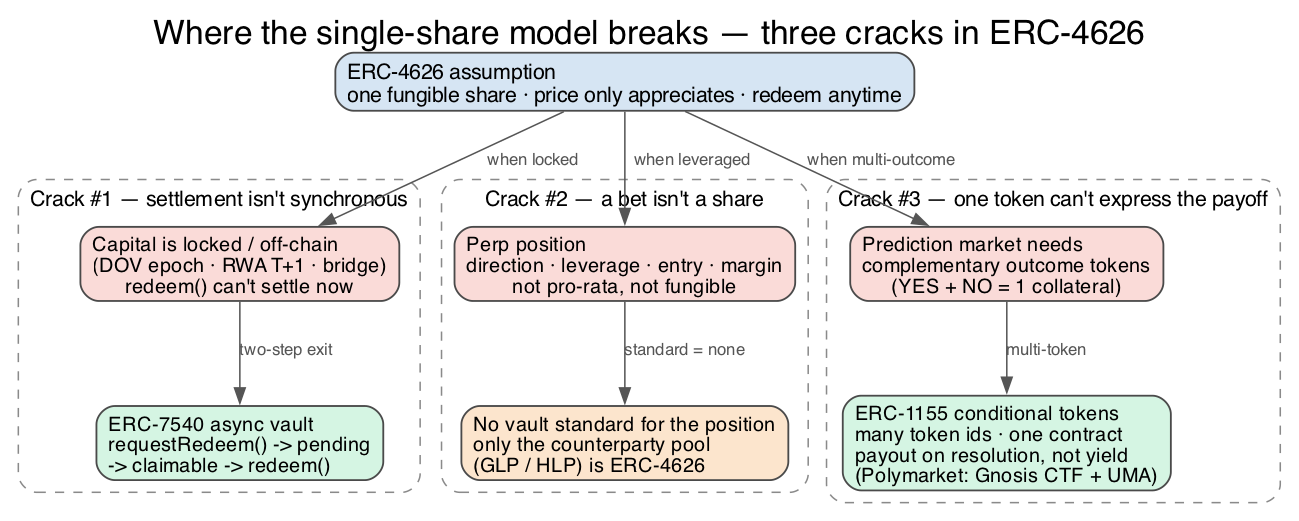
Part 1 made a clean claim: option vaults, lending markets, and perp LP pools are all the same chassis — deposit an asset, get one fungible share, let a strategy grow totalAssets so the share appreciates. That model is powerful because it's narrow. This follow-up is about the three places the narrowness shows: when settlement can't be synchronous (ERC-7540), when the position isn't a share at all (perps), and when a single appreciating token simply can't express the payoff (ERC-1155 conditional tokens, the standard behind Polymarket).


0. Recap in one paragraph

Part 1's whole trick was pricePerShare = totalAssets / totalSupply. Yield is anything that grows totalAssets while share supply stays flat: a DOV's option premium, a lending market's interest, a perp LP's funding. One standard, three engines, three risk shapes. But baked into that model are two silent assumptions — (a) you can always redeem your share right now for its current value, and (b) the entire position collapses to one fungible token whose price only goes up (or down) along a single axis. Each section below breaks one of those assumptions.

Map of where the single-share model breaks


1. Crack #1 — settlement isn't always synchronous → ERC-7540

Part 1 name-dropped ERC-7540 in the DOV section and moved on. It deserves a proper look, because it's the standard that fixes the single most common ERC-4626 mismatch.

Vanilla ERC-4626 assumes withdraw() / redeem() settle atomically — the assets are sitting in the contract, ready to hand back this block. That's true for a lending wrapper (Aave liquidity is usually on demand). It is false for anything whose capital is temporarily unreachable:

  • a DOV with collateral locked inside a live option until expiry,
  • an RWA vault whose underlying is a T-bill that settles T+1 off-chain,
  • a cross-chain vault waiting on a bridge message.

For all of these, redeem() can't return funds synchronously — so the naive fix (revert until the epoch ends) makes the share illiquid and breaks every integrator that assumes 4626 semantics.

What ERC-7540 adds

ERC-7540 is a superset of ERC-4626 that turns deposit and redeem into two-step, asynchronous flows. Nothing about the accounting changes — pricePerShare still rules — only the timing of when you can act.

Phase ERC-4626 ERC-7540
Enter deposit() — mints shares now requestDeposit() → (pending) → later deposit()/mint() claims the shares
Exit redeem() — returns assets now requestRedeem() → (pending) → later redeem()/withdraw() claims the assets
State you can query pendingRedeemRequest() and claimableRedeemRequest() per controller

The lifecycle is pending → claimable → claimed. You submit a request (your shares are escrowed), the vault fulfils it when its strategy can free the capital (epoch settles, bridge confirms, T-bill matures), and only then does your request become claimable.

// ERC-7540 async redeem, stripped to the essentials.
// The vault escrows shares on request and settles them when capital is free.
interface IERC7540Redeem {
    // Step 1: queue it. Shares move into escrow now; assets come later.
    function requestRedeem(uint256 shares, address controller, address owner)
        external returns (uint256 requestId);

    // How much of my request has the vault made claimable so far?
    function claimableRedeemRequest(uint256 requestId, address controller)
        external view returns (uint256 claimableShares);

    // Step 2: once claimable (epoch settled), pull the assets out.
    function redeem(uint256 shares, address receiver, address controller)
        external returns (uint256 assets);
}

Takeaway: ERC-7540 doesn't change what a share is worth — it changes when you're allowed to trade it back. It's the honest interface for any strategy that can't promise instant liquidity. A DOV is "4626 accounting + option strategy in totalAssets + a 7540 withdrawal queue."


2. Crack #2 — a bet isn't a share → perps have no vault standard

Part 1 flagged this and it's worth stating plainly, because it's the cleanest example of "not everything is a vault."

An ERC-4626 share is pro-rata and fungible: every share is identical, and your claim is yourShares / totalSupply of one pool. A perp position is neither. It has a direction (long/short), a leverage, an entry price, a liquidation price, and margin that's specific to you. Two traders in "the same" ETH perp hold completely different instruments. There's nothing to tokenize as one fungible share, so there is no vault standard for a perp position — it's an entry in the exchange's margin ledger, not an ERC-20/4626 token.

Where 4626 does come back is the other side of the trade. The liquidity that stands as counterparty to every trader — GMX's GLP, Hyperliquid's HLP — is a pooled, fungible, appreciating share. That's Part 1's "perp LP vault" engine. So the rule is:

  • The position (one trader's leveraged bet) → no standard, lives in the margin engine.
  • The counterparty pool (the house) → ERC-4626, earns funding + fees − trader PnL.

Perps are the reminder that "is this an ERC-4626 vault?" has a real answer, and sometimes it's no.


3. Crack #3 — one appreciating token can't express the payoff → ERC-1155 conditional tokens

Now the genuinely different one. And to be precise about the framing: a prediction market is not a fourth yield engine. The three engines in Part 1 all answer the same question — "what makes totalAssets grow?" A prediction market has no growing pool and no yield. It's a payout instrument: you buy a claim on a future event, and at resolution it pays exactly 1 unit of collateral if you were right and 0 if you were wrong. Different question entirely — not "what grows the pool?" but "what resolves this, and to what?"

That difference forces a different token standard.

Why ERC-4626 can't do it, and ERC-1155 can

A market on "Will X happen?" needs two complementary tokens — a YES and a NO — that (a) are each independently fungible and tradeable, (b) share one lifecycle and settlement, and (c) obey the invariant YES + NO = 1 unit of collateral. A multi-outcome market ("who wins the election?") needs N such tokens. ERC-4626 gives you exactly one share per vault. It structurally can't represent a set of complementary outcome tokens.

ERC-1155 — the multi-token standard — is built for exactly this. One contract holds many token ids, each id being its own fungible balance, with batch transfers and shared logic. One deployment, N outcome tokens, cheap and atomic. That's why every serious prediction market sits on it.

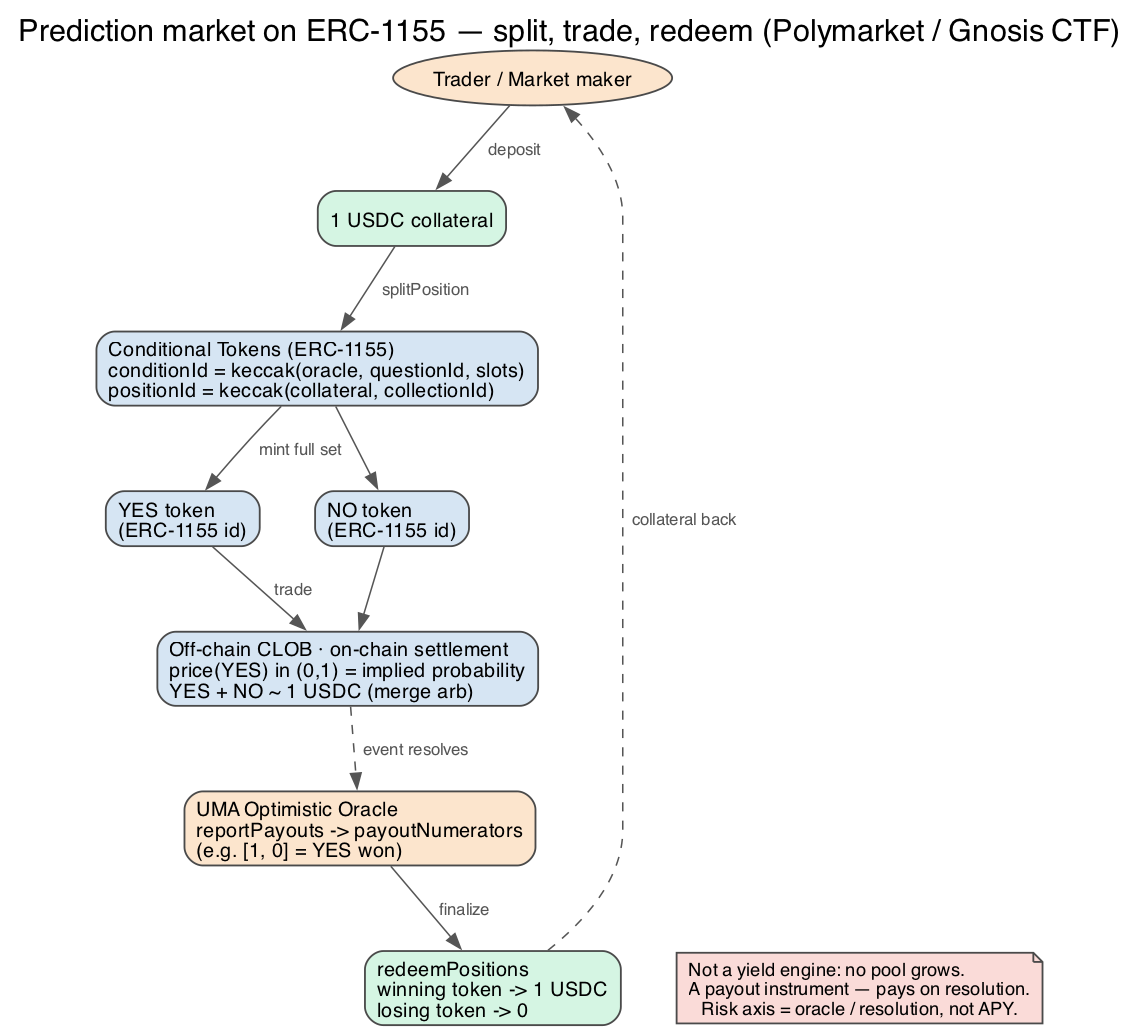
ERC-1155 conditional tokens: split, trade, redeem

The Polymarket stack

Polymarket is the canonical example. Its plumbing:

Layer What it is
Collateral USDC (on Polygon).
Token layer Gnosis Conditional Tokens Framework (CTF) — an ERC-1155 contract that mints outcome tokens.
Resolution UMA Optimistic Oracle (via the CTF adapter) reports which outcome won.
Trading An off-chain CLOB (central limit order book) for price discovery, with on-chain settlement through the CTF Exchange contract — non-custodial, atomic swaps of outcome tokens ↔ USDC. (Early Polymarket used an LMSR AMM; the order book replaced it for tighter spreads.)

The mechanic — split, trade, redeem

  1. Prepare the condition. Someone registers the question: conditionId = keccak256(oracle, questionId, outcomeSlotCount). For a binary market, outcomeSlotCount = 2.
  2. Split collateral into a full set. Call splitPosition with 1 USDC → you receive 1 YES token and 1 NO token. Collateral is locked in the CTF contract; you now hold both legs. This is the primary mint — a market maker does it, then sells the legs they don't want.
  3. Each leg is an ERC-1155 id. The id is derived deterministically: conditionId + an indexSet (which outcome) → a collectionIdpositionId = keccak256(collateral, collectionId). That positionId is the ERC-1155 token id you hold and trade.
  4. Trade on the order book. A YES token trades at a price ∈ (0, 1), and that price is the market's implied probability. Arbitrage pins YES + NO ≈ 1 USDC: if the pair trades below 1 you buy both and mergePositions back into 1 USDC risk-free; above 1 you split and sell.
  5. Resolution. After the event, UMA's oracle reports payoutNumerators (e.g. [1, 0] — YES won). Holders call redeemPositions: each winning token burns for 1 USDC, each losing token for 0. The market is settled.
// Gnosis Conditional Tokens (ERC-1155), reduced to the three moves that matter.
interface IConditionalTokens /* is ERC1155 */ {
    // 1 USDC of collateral -> one token of EACH outcome in `partition` (e.g. [1,2] = YES,NO).
    // Locks collateral, mints the complementary set. YES + NO = 1 collateral, always.
    function splitPosition(
        IERC20 collateralToken,
        bytes32 parentCollectionId,
        bytes32 conditionId,
        uint256[] calldata partition,
        uint256 amount
    ) external;

    // The inverse: burn a full set back into collateral (this is the arb that pins YES+NO=1).
    function mergePositions(
        IERC20 collateralToken,
        bytes32 parentCollectionId,
        bytes32 conditionId,
        uint256[] calldata partition,
        uint256 amount
    ) external;

    // After the oracle calls reportPayouts, winners burn outcome tokens for collateral
    // pro-rata to payoutNumerators / payoutDenominator. Losing tokens redeem for 0.
    function redeemPositions(
        IERC20 collateralToken,
        bytes32 parentCollectionId,
        bytes32 conditionId,
        uint256[] calldata indexSets
    ) external;
}

The risk axis is completely different

A DOV's tail risk is short-volatility blow-ups; a lending vault's is bad debt. A prediction market has neither, because there's no strategy and no pool to impair. Its dominant risk is resolution/oracle risk:

  • Ambiguous questions — a poorly-specified market where "what actually happened" is genuinely contested (the infamous edge cases where the event is clear but the market wording isn't).
  • Oracle disputes — UMA proposals can be disputed and escalated to a token-holder vote (the DVM); resolution can be delayed or, in adversarial cases, contested by economic pressure on the voting token.
  • Settlement latency — your capital is tied up until the oracle finalizes, which can be days after the real-world event.

There's no "APY" here and no pricePerShare. The only questions that matter are how is this resolved, by whom, and how cleanly is it worded.


4. Putting Part 1 and Part 2 together

Three token models, three questions a depositor/holder should actually ask:

ERC-4626 vault ERC-7540 async vault ERC-1155 conditional tokens
Token you hold One fungible appreciating share Same share, async claim N complementary outcome tokens (YES/NO/…)
What "price" means totalAssets / totalSupply, unbounded up Same Implied probability ∈ (0,1); set sums to 1
Yield? Yes — strategy grows totalAssets Yes — same, capital just illiquid No — it's a payout, not yield
Settlement trigger Synchronous — redeem anytime Request → claim when strategy frees capital Redeem after oracle resolution
Dominant risk Strategy tail (short-vol / bad debt / adverse selection) Same + liquidity-timing Resolution / oracle risk
Examples Ribbon, Aave, Morpho, GLP, HLP DOVs, RWA vaults, cross-chain vaults Polymarket (Gnosis CTF + UMA)

The one-line upgrade to Part 1's mental model:

  • ERC-4626 (and its async sibling 7540) is for "one share that appreciates" — ask what makes totalAssets go up, and what makes it crash.
  • ERC-1155 conditional tokens are for "many binary claims that resolve" — ask what resolves this, and to what.
  • And some things — a perp position — are neither, and that's a real answer too.

Same DeFi surface, three fundamentally different objects underneath. Knowing which one you're holding is the risk analysis.


Continued in Part 3 — When DeFi Stops Being DeFi. Parts 1 and 2 varied the shape of the claim but never left the permissionless model — the answer to "who can hold this?" was always anyone. Part 3 is the axis where that breaks: real-world assets carry the law of a jurisdiction, that law has to be enforced on-chain, and permissioned tokens (ERC-3643, permissioned 4626/7540 vaults) become the seam where DeFi rails meet TradFi rules.

From One Standard to Three Yield Engines

DOVs, Perps, and how ERC-4626 ties DeFi yield together

A single mental model: deposit an asset, receive a tokenized share, and let a strategy make that share worth more over time. Option vaults, lending markets, and perp liquidity pools all run on this exact plumbing — they only differ in the engine that grows the pool. This primer walks the standard first, then each engine, and shows how they connect.

ERC-4626 is the cornerstone of DeFi because it's the base case — the simplest possible vault, and it works precisely because it assumes so little. That's also the frame for everything that follows: once you plug in assets that behave differently — capital that locks up, positions that aren't shares, payoffs that resolve to a yes/no — new challenges arise that the base standard can't answer on its own, and each gets addressed separately. This post is the base case; Part 2 is where those challenges (and the standards that solve them) come in.


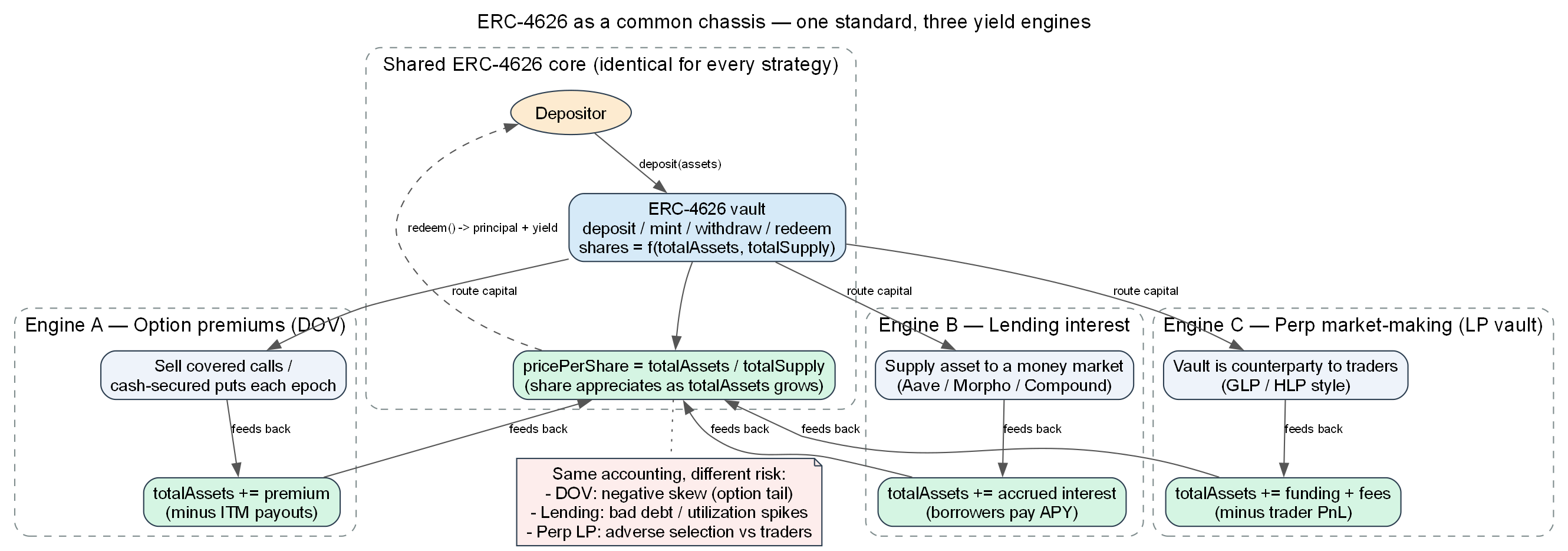
0. The one diagram: same chassis, three different engines

ERC-4626 as a common chassis

The core in the middle is identical no matter which engine you plug in. deposit() mints shares; the strategy grows totalAssets; pricePerShare rises; redeem() returns principal plus accrued yield. Everything below is just "what is the engine, and how does its risk differ."


1. ERC-4626 in five minutes

ERC-4626 is the tokenized vault standard. It wraps a single underlying asset and represents each depositor's claim as a fungible ERC-20 share. That standardization is why aggregators, front-ends, and other contracts can integrate any vault without custom glue.

The core interface

Function What it does
asset() Address of the underlying token the vault holds (e.g. ETH, USDC).
deposit(assets, receiver) Pulls assets in, mints shares to receiver.
mint(shares, receiver) Same, but you specify the shares you want out.
withdraw(assets, receiver, owner) Burns shares, returns a specific amount of assets.
redeem(shares, receiver, owner) Burns a specific number of shares, returns the assets they're worth.
totalAssets() Total underlying currently controlled by the vault.
convertToShares / convertToAssets The exchange-rate helpers.

The one formula

\[\text{pricePerShare} = \frac{\text{totalAssets}}{\text{totalSupply}}\]

Yield happens whenever totalAssets grows while totalSupply (shares outstanding) stays the same. The share silently appreciates. No rebasing, no reward tokens to claim — the number of shares in your wallet is constant, but each one redeems for more.

Worked example

  1. Ten users deposit 100 ETH into a fresh vault → totalAssets = 100, totalSupply = 100, so 1 share = 1 ETH.
  2. The strategy earns 5 ETH (a premium, interest, or funding — pick your engine) → totalAssets = 105, totalSupply still 100.
  3. convertToAssets(1 share) = 105 / 100 = 1.05 ETH.
  4. A user calling redeem(10 shares) burns them and receives 10.5 ETH.

The one security footgun: the inflation / donation attack

Because the rate is totalAssets / totalSupply, an attacker who is the first depositor can mint 1 wei of shares, then donate a large amount of the asset directly to the vault (bypassing deposit). This inflates pricePerShare so the next depositor's rounding-down mint gives them zero shares, and the attacker redeems the victim's deposit. Mitigations: seed the vault with dead shares at deploy, use "virtual shares/assets" offsets (OpenZeppelin v4.9+ does this), or require a minimum first deposit. Keep this in mind for every engine below — it's a property of the standard, not of any one strategy.

// Minimal ERC-4626 vault (OpenZeppelin). The strategy is whatever moves `totalAssets`.
contract YieldVault is ERC4626 {
    constructor(IERC20 asset_) ERC4626(asset_) ERC20("Vault Share", "vSHARE") {}

    // deposit(), mint(), withdraw(), redeem(), convertToAssets() are all inherited.
    // The ONLY thing a strategy must do to pay yield is grow totalAssets():
    //   - a DOV collects an option premium   -> asset balance goes up
    //   - a lending wrapper accrues interest  -> aToken balance goes up
    //   - a perp LP vault earns funding/fees  -> collateral balance goes up
    // Shares are untouched, so pricePerShare rises for everyone. That's the whole trick.

    function totalAssets() public view override returns (uint256) {
        // Override to report principal + whatever the strategy is currently worth.
        return _deployedCapital() + IERC20(asset()).balanceOf(address(this));
    }
}

2. Engine A — Decentralized Option Vaults (DOVs)

A DOV automates an options-selling strategy into deposit-and-earn. The vault sells options, collects the premium, and that premium is the yield. It runs on a recurring epoch (weekly or bi-weekly).

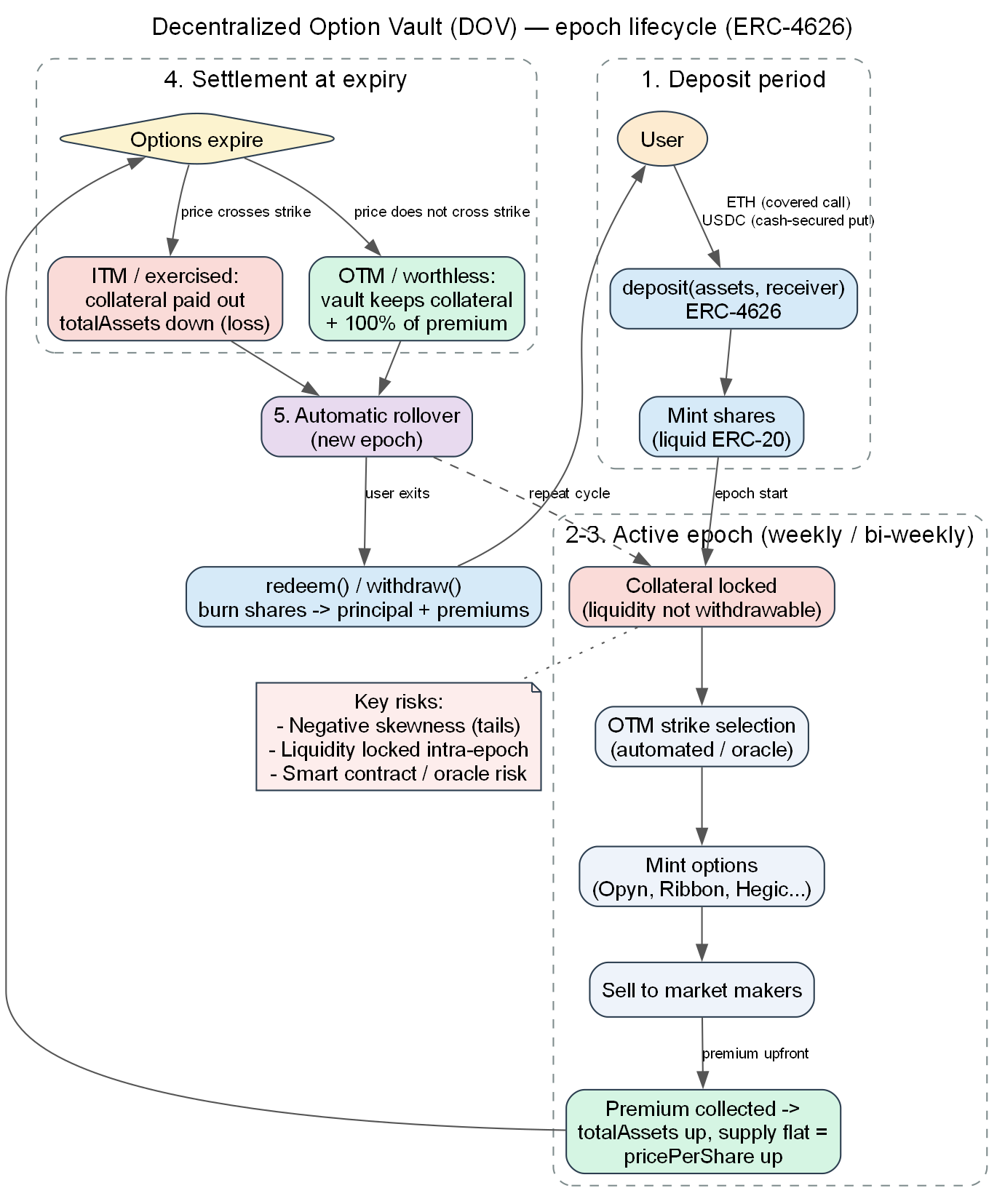
DOV epoch lifecycle

Lifecycle of one epoch

  1. Deposit window — users deposit the underlying. A covered-call vault takes a volatile asset (ETH); a cash-secured-put vault takes a stablecoin (USDC). deposit() mints shares.
  2. Strike selection & minting — the epoch starts, collateral is locked, an automated mechanism (or manager via oracle) picks an out-of-the-money strike (e.g. +10% for a weekly call), and the vault mints the option through an options protocol (Opyn, Ribbon, Hegic).
  3. Sell for premium — the option is sold to market makers. The premium is paid upfront and lands back in the vault → totalAssets ↑, supply flat → pricePerShare ↑.
  4. Settlement at expiry, two outcomes:
  5. ITM / exercised — price moved through the strike; the vault pays out collateral → totalAssets ↓ → net loss.
  6. OTM / worthless — strategy won; the vault keeps 100% of collateral plus the premium.
  7. Rollover / exit — the cycle auto-repeats; anyone exiting calls redeem() / withdraw() to burn shares for principal + accumulated premiums.

Covered call vs cash-secured put

Covered Call Vault Cash-Secured Put Vault
Deposits Volatile crypto (ETH) Stablecoin (USDC)
Outlook Moderately bullish / sideways Moderately bearish / sideways
asset() returns ETH address USDC address
If price rips up Gets "called" — upside capped at strike Max profit, keeps full premium
If price crashes Holds a depreciating asset (USD loss) Forced to buy the asset at a loss with USDC

Risks

  • Negative skewness — many small consistent premium wins, punctuated by rare large losses in high-vol events. You are short volatility.
  • Locked liquidity — most DOVs block mid-epoch withdrawals because collateral is tied up in an open option.
  • Smart-contract / oracle risk — depends on the options protocol and on price oracles (Chainlink) to settle strikes.

3. How ERC-4626 implements a DOV — the connective tissue

This is where the standard and the strategy meet. The DOV is not a separate technology; it is an ERC-4626 vault whose totalAssets is moved by option premiums and payouts.

The mapping, function by function:

DOV concept ERC-4626 mechanism
"What do I deposit?" asset() returns ETH (covered call) or USDC (CSP).
Getting a claim on the pool deposit() mints shares pro-rata at the current pricePerShare.
Premium becomes yield Premium increases the vault's asset balance → totalAssets() returns more → every share appreciates. Supply is untouched.
Loss on an exercised option Collateral leaves the vault → totalAssets() returns less → shares depreciate. Same accounting, opposite sign.
Exiting with your gains redeem(shares) burns shares for convertToAssets(shares) = principal + net premiums.
// DOV-flavoured overrides. Everything is standard ERC-4626 except two hooks.
contract CoveredCallVault is ERC4626 {
    uint256 public lockedCollateral;   // tied up in the live option this epoch
    uint256 public premiumBuffer;      // premiums collected, waiting to settle

    // Yield/loss enter the system ONLY by changing this number.
    function totalAssets() public view override returns (uint256) {
        return IERC20(asset()).balanceOf(address(this))  // idle collateral
             + lockedCollateral                          // collateral in the option
             + premiumBuffer;                            // premiums already earned
    }

    function startEpoch(uint256 strike) external onlyManager {
        // lock collateral, mint + sell the option, receive premium
        lockedCollateral = IERC20(asset()).balanceOf(address(this));
        uint256 premium = _mintAndSellOption(strike, lockedCollateral);
        premiumBuffer += premium;      // <-- totalAssets just went up => pricePerShare up
    }

    function settleEpoch() external onlyManager {
        (bool exercised, uint256 payout) = _settleOption();
        if (exercised) lockedCollateral -= payout;   // <-- totalAssets down => loss booked
        premiumBuffer = 0;
        lockedCollateral = 0;                          // collateral returns to idle balance
    }
}

The one real friction: instant-liquidity assumption

Vanilla ERC-4626 assumes withdraw/redeem can settle synchronously — the assets are always there. A DOV violates this during the epoch because collateral is locked inside a live option. Two production patterns solve it:

  • Windowed withdrawals — the vault only honours redeem() between epochs; mid-epoch calls revert. Simple, but capital is illiquid for up to a week.
  • Request-based / async vaults (ERC-7540) — an extension of ERC-4626 that splits withdrawal into requestRedeem() (queue it now) and a later redeem() (claim once the epoch settles). This is the emerging standard for any vault whose strategy can't return funds on demand — DOVs, RWA vaults, and cross-chain vaults all use it. Part 2 walks the full pending → claimable → claimed lifecycle.

Takeaway: a DOV is "ERC-4626 + an option strategy in totalAssets + an async-withdrawal shim." Nothing more exotic.


4. Engine B — Perpetual Futures (Perps)

Perps deserve their own section because they are the one piece here that is not itself an ERC-4626 vault — yet they show up inside ERC-4626 vaults constantly. Understand the mechanic first.

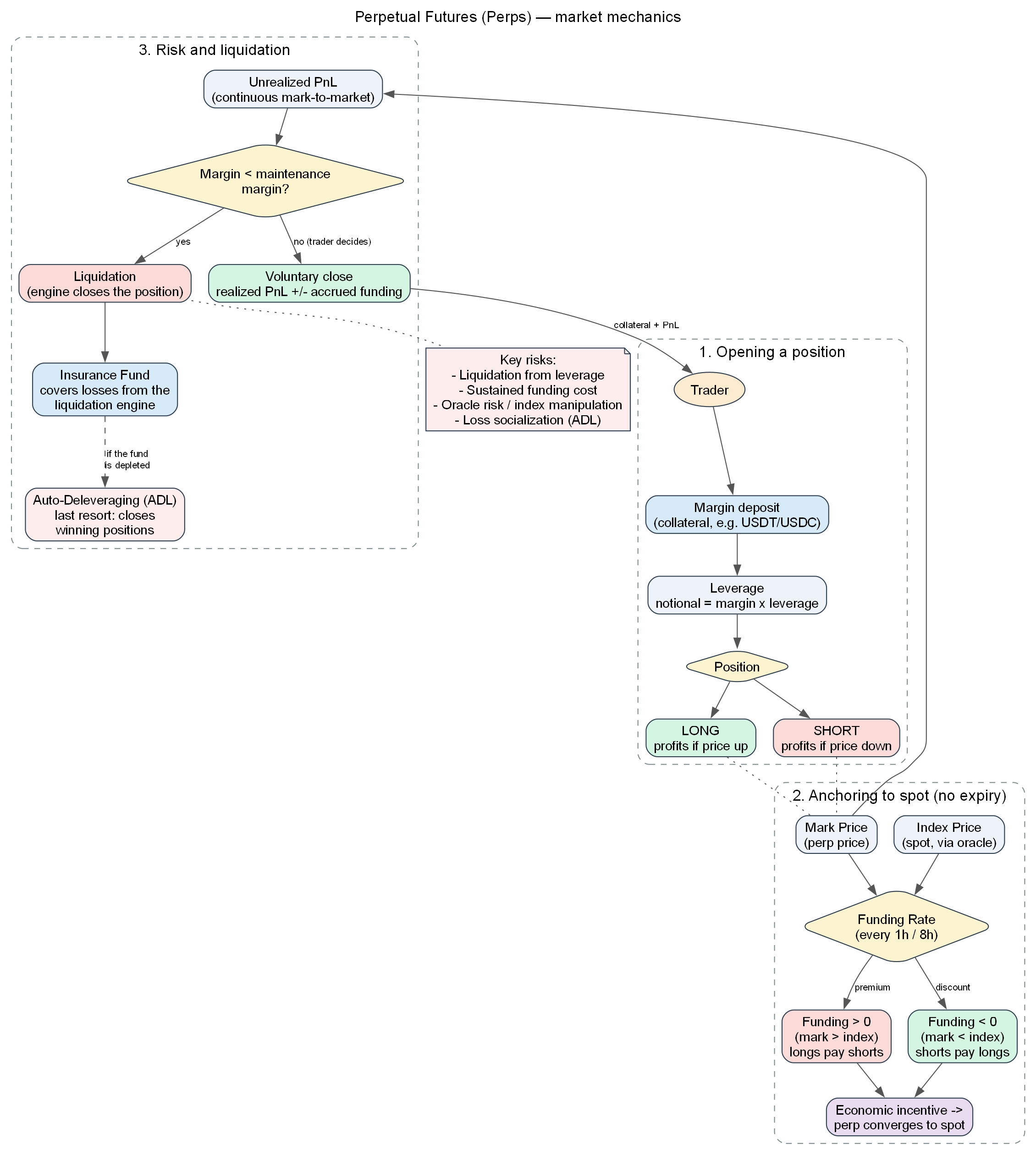
Perp market mechanics

Mechanics

  1. Open a position — deposit margin (collateral, e.g. USDC), pick leverage (notional = margin × leverage), go LONG (profit if price ↑) or SHORT (profit if price ↓).
  2. Anchoring to spot without expiry — a perp never expires, so it needs a force pulling its price to spot. That's the funding rate, exchanged every 1h/8h between longs and shorts:
  3. Mark > Index (perp trading rich) → funding positive → longs pay shorts.
  4. Mark < Index (perp trading cheap) → funding negative → shorts pay longs.
  5. Either way, the economic incentive drags the perp back toward the spot index price (fed by an oracle).
  6. Risk & liquidation — unrealized PnL is marked-to-market continuously. If margin drops below the maintenance margin, the engine liquidates the position. Losses beyond the collateral hit the insurance fund; if that's exhausted, auto-deleveraging (ADL) force-closes profitable traders as a last resort.

Risks

  • Liquidation from leverage, sustained funding cost, oracle/index manipulation, and socialized losses via ADL.

Where ERC-4626 comes back in

A single perp position is one trader's individual bet — not a pooled share, so it isn't ERC-4626. But the liquidity that stands on the other side of every trader usually is a tokenized vault:

  • LP / market-maker vaults (GLP-style on GMX, HLP on Hyperliquid): depositors pool collateral, the pool is the counterparty to all traders, and it earns funding + trading fees minus trader PnL. That net flow moves totalAssets, and depositors hold vault shares. This is Engine C in the overview diagram.
  • Delta-neutral vaults: an ERC-4626 vault that holds spot and a short perp of equal size, harvesting funding while hedging price. The share appreciates from funding income; the strategy just happens to live partly in a perp.

So perps are both a standalone product and a component other ERC-4626 vaults wrap for yield.


5. Engine C — ERC-4626 in lending protocols

Lending is the cleanest example of ERC-4626 as a pure yield wrapper, and it predates DOVs in the standard's adoption.

The mechanic

You supply an asset to a money market (Aave, Compound, Morpho). Borrowers pay interest. That interest accrues to suppliers, so the supplier's claim grows over time — exactly the totalAssets ↑, supply flat pattern.

  • Aave issues aTokens (aUSDC, aWETH) that rebase to reflect accrued interest, and Aave v3 now ships ERC-4626 vaults on top so integrators get the standard interface.
  • Morpho / MetaMorpho vaults are natively ERC-4626: you deposit into a curated vault, it allocates across underlying lending markets, and pricePerShare climbs with interest.
  • Yearn popularized the pattern — a "yVault" is an ERC-4626 share whose totalAssets is deployed into whatever strategy earns the most, lending included.
// A lending wrapper is even simpler than a DOV: no epochs, no options, no async exit.
contract LendingVault is ERC4626 {
    IPool public immutable aavePool;

    function totalAssets() public view override returns (uint256) {
        // aToken balance already includes accrued interest -> totalAssets grows passively.
        return aToken.balanceOf(address(this));
    }

    function _deposit(address caller, address receiver, uint256 assets, uint256 shares)
        internal override
    {
        super._deposit(caller, receiver, assets, shares);
        aavePool.supply(asset(), assets, address(this), 0); // put capital to work
    }
    // Withdrawals are synchronous: lending liquidity is (usually) available on demand,
    // so no ERC-7540 request queue is needed — the key contrast with a DOV.
}

Why it matters for the comparison

Lending is the low-skew engine: yield is small and steady, and the tail risk is bad debt (a borrower position going underwater faster than it can be liquidated) or a utilization spike freezing withdrawals — not a short-volatility blow-up like a DOV. Same chassis, very different risk shape.


6. Putting it together

The whole point: one standard, three engines, three risk profiles.

DOV Lending vault Perp LP vault
You deposit ETH or USDC Any supported asset USDC / basket collateral
Yield source Option premiums Borrower interest Funding + fees − trader PnL
What grows totalAssets Premium collected each epoch Interest accrued continuously Net flow from being the house
Liquidity Locked per epoch (often ERC-7540 async) Usually on-demand On-demand, subject to utilization
Skew / tail risk Negative (short vol; rare big losses) Low (bad debt, utilization) Adverse selection vs skilled traders
Example protocols Ribbon, Thetanuts, Opyn Aave, Morpho, Yearn GMX (GLP), Hyperliquid (HLP)

If you remember one thing: ERC-4626 is the accounting, the strategy is the engine. pricePerShare = totalAssets / totalSupply is true in all three; the only question a depositor should ask is "what makes totalAssets go up, and what makes it crash?"


Continued in Part 2 — Beyond ERC-4626. This model rests on two quiet assumptions: that you can redeem a share the instant you want, and that the whole position collapses to one appreciating token. Part 2 is the three places that breaks — async settlement (ERC-7540), perps that aren't vaults at all, and prediction markets on ERC-1155 conditional tokens, where the right question stops being "what grows the pool?" and becomes "what resolves this, and to what?"

The Invisible Guardian: Deploying a Bulletproof AI Agent with OpenClaw and AWS KMS

In the world of autonomous AI agents, your greatest asset is also your biggest liability: the Private Key. If an agent is tasked with managing a Web3 wallet or accessing sensitive financial APIs, that key is the "golden ticket" for any hacker.

The traditional approach—storing keys in a .env file or a local database—is a disaster waiting to happen. If your server is breached, your funds are gone before you can even log in to check the logs. Today, we are exploring a narrative of "The Key That Isn't There," using a high-security architecture involving Hetzner, Tailscale, and AWS KMS/Secrets to deploy OpenClaw safely.


The Context: A World of "When," Not "If"

Standard VPS security usually stops at "use a strong password." But for an AI agent with financial autonomy, that isn't enough. We have to assume three things:

  1. Public IPs are targets: Bots scan every open port on the internet constantly.

  2. Software has bugs: Even the best code can have vulnerabilities that allow remote access.

  3. Local secrets are vulnerable: If a secret is on the disk, it is as good as stolen once a hacker gains entry.


The Solution: The "Zero-Trust" Infrastructure

We solve this by building a server that is invisible to the public and a wallet that never exists in memory or on disk.

1. The Invisible Fortress (Tailscale & UFW)

We start by making the server "disappear" from the public internet.

  • Tailscale: We install a VPN tunnel so that management (SSH) only happens over a private, encrypted network.

  • The UFW Shield: We configure the Uncomplicated Firewall to deny all incoming traffic on the public interface (eth0), allowing SSH only through the tailscale0 interface.

  • The Result: If someone tries to scan your Hetzner IP, they get nothing. The door simply isn't there.

2. The Key Without a Body (AWS KMS)

Instead of a local wallet, we use AWS KMS (Key Management Service) to create an asymmetric ECC_SECG_P256K1 key.

  • Hardware Security: The private key is generated inside an AWS HSM (Hardware Security Module) and never leaves it.

  • Signing, Not Storing: When OpenClaw needs to sign a transaction, it sends the data to AWS. AWS signs it and sends the signature back. The VPS never sees the actual key.

  • Secrets, in the Vault: The rest of the secrets that are not private keys (API keys, passphrases,...), can be stored in the AWS Secrets Manager and only loaded in memory for the processes that is going to use them, with temporary AWS Keys.

  • IP Locking: We apply a strict IAM policy that only allows the kms:Sign or/and secretsmanager:GetSecretValue action if the request originates from your specific Hetzner IP. Even if your AWS credentials are stolen, they are useless outside your server.

3. The "Kill Switch" (Falco & Lambda)

If a hacker somehow breaches the VPS, we don't wait for a manual response. We use Falco to monitor system calls in real-time.

  • Detection: Falco triggers an alert if any unauthorized process (like a manual shell) tries to access credentials.

  • The Guillotine: This alert hits a webhook that triggers an AWS Lambda function. This "Kill Switch" immediately revokes all active sessions and permissions for the agent. The attacker is locked out of the wallet in milliseconds, effectively sealing all secrets and Sign capabilities.


The Future: Toward Immutable Autonomy

This setup marks a shift from "reactive" security to architectural immunity. By using Cloud-init to automate these configurations from the first boot, we ensure no human error leaves a door open.

Final Thoughts

As we move toward a future populated by millions of autonomous agents, the "Server as a Bunker" model will become the standard. We aren't just protecting data; we are protecting the agency and reputation of our digital twins.

Threat Applied Technical Mitigation
Wallet Theft
AWS KMS: The private key does not exist on the server.
AWS Creds Theft
IP Locking: Keys are useless outside the VPS.
Remote Command Execution
Falco Killswitch: Any detection revokes access to secrets and signing power in milliseconds.
Persistence
Auto-Updates & Inmutability: Rebuild the VPS weekly.
Unauthorized Access
IP Locking & Tailscale: Access is restricted to a private tunnel and specific IPs.