Skip to content

blockchain

The Invisible Guardian: Deploying a Bulletproof AI Agent with OpenClaw and AWS KMS

In the world of autonomous AI agents, your greatest asset is also your biggest liability: the Private Key. If an agent is tasked with managing a Web3 wallet or accessing sensitive financial APIs, that key is the "golden ticket" for any hacker.

The traditional approach—storing keys in a .env file or a local database—is a disaster waiting to happen. If your server is breached, your funds are gone before you can even log in to check the logs. Today, we are exploring a narrative of "The Key That Isn't There," using a high-security architecture involving Hetzner, Tailscale, and AWS KMS to deploy OpenClaw safely.


The Context: A World of "When," Not "If"

Standard VPS security usually stops at "use a strong password." But for an AI agent with financial autonomy, that isn't enough. We have to assume three things:

  1. Public IPs are targets: Bots scan every open port on the internet constantly.

  2. Software has bugs: Even the best code can have vulnerabilities that allow remote access.

  3. Local secrets are vulnerable: If a secret is on the disk, it is as good as stolen once a hacker gains entry.


The Solution: The "Zero-Trust" Infrastructure

We solve this by building a server that is invisible to the public and a wallet that never exists in memory or on disk.

1. The Invisible Fortress (Tailscale & UFW)

We start by making the server "disappear" from the public internet.

  • Tailscale: We install a VPN tunnel so that management (SSH) only happens over a private, encrypted network.

  • The UFW Shield: We configure the Uncomplicated Firewall to deny all incoming traffic on the public interface (eth0), allowing SSH only through the tailscale0 interface.

  • The Result: If someone tries to scan your Hetzner IP, they get nothing. The door simply isn't there.

2. The Key Without a Body (AWS KMS)

Instead of a local wallet, we use AWS KMS (Key Management Service) to create an asymmetric ECC_SECG_P256K1 key.

  • Hardware Security: The private key is generated inside an AWS HSM (Hardware Security Module) and never leaves it.

  • Signing, Not Storing: When OpenClaw needs to sign a transaction, it sends the data to AWS. AWS signs it and sends the signature back. The VPS never sees the actual key.

  • IP Locking: We apply a strict IAM policy that only allows the kms:Sign action if the request originates from your specific Hetzner IP. Even if your AWS credentials are stolen, they are useless outside your server.

3. The "Kill Switch" (Falco & Lambda)

If a hacker somehow breaches the VPS, we don't wait for a manual response. We use Falco to monitor system calls in real-time.

  • Detection: Falco triggers an alert if any unauthorized process (like a manual shell) tries to access credentials.

  • The Guillotine: This alert hits a webhook that triggers an AWS Lambda function. This "Kill Switch" immediately revokes all active sessions and permissions for the agent. The attacker is locked out of the wallet in milliseconds.


The Future: Toward Immutable Autonomy

This setup marks a shift from "reactive" security to architectural immunity. By using Cloud-init to automate these configurations from the first boot, we ensure no human error leaves a door open.

Final Thoughts

As we move toward a future populated by millions of autonomous agents, the "Server as a Bunker" model will become the standard. We aren't just protecting data; we are protecting the agency and reputation of our digital twins.

Threat Applied Technical Mitigation
Wallet Theft
AWS KMS: The key does not exist on the server.
AWS Creds Theft
IP Locking: Keys are useless outside the VPS.
Remote Command Execution
Falco Killswitch: Any detection revokes access in milliseconds.
Persistence
Auto-Updates & Inmutability: Rebuild the VPS weekly.
Unauthorized Access
IP Locking & Tailscale: Access is restricted to a private tunnel and specific IPs.

How x402 is Building the "Wallet" for the AI Web

For thirty years, the internet has had a bug. It wasn’t a code error or a security vulnerability, but a missing piece of the foundation. In 1994, the architects of the web created a status code—HTTP 402 Payment Required—but they never finished building the technology to make it work.

Without a native way to send money over the internet, we built a web fueled by ads and data tracking. This worked for humans, but a new actor is entering the chat: Artificial Intelligence.

AI agents don't watch ads, and they can't fill out credit card forms. To function, they need a way to pay for data and services instantly and autonomously. This is where x402 comes in—a new protocol that finally fixes the internet's "original sin" and paves the way for the Agentic Economy.


What is x402?

Think of x402 as a digital debit card built directly into the web browser's code. It is an open payment standard that revives the dormant HTTP 402 status code to allow machines to pay other machines for data, access, or services without human intervention.

Currently, if you want to access premium data, you encounter a "403 Forbidden" error or a login screen. With x402, the server simply replies "Payment Required" and tells your software exactly how much crypto (like USDC) it costs to proceed. Your software pays it instantly, and the door opens.

This shifts payments from "Systems of Engagement" (like a Stripe checkout page designed for human eyes) to "Systems of Execution" (code that just gets the job done).


How It Works: The "Digital Handshake"

The magic of x402 happens in the background. It changes the conversation between your computer (the Client) and the website (the Server).

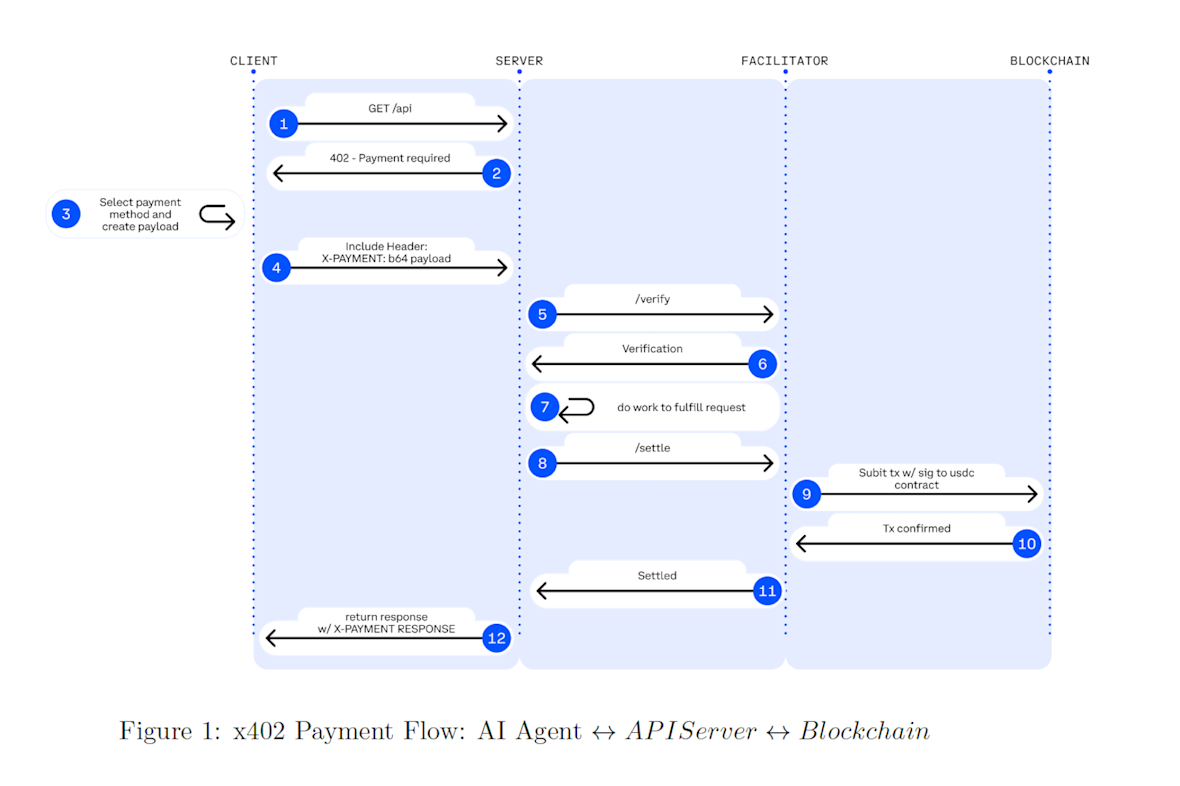
Here is the step-by-step flow of an x402 transaction:

  1. The Knock (Request): An AI agent tries to access a paid service (e.g., "Get me the latest stock prices").
  2. The Challenge (402 Response): instead of blocking the agent, the server replies with a 402 error. It attaches a "price tag" in the header saying, "I accept 0.01 USDC on the Base network".
  3. The Commitment (Signing): The agent's digital wallet sees the price tag. It cryptographically signs a promise to pay. This is like signing a check without handing it over yet.
  4. The Entry (X-PAYMENT Header): The agent knocks again, this time showing the signed check in a special header called X-PAYMENT.
  5. The Settlement (Facilitator): The server checks the signature. To avoid dealing with complex blockchain fees and slowness, the server uses a "Facilitator"—a middleman service—to process the crypto transaction on the blockchain. Once confirmed, the agent gets the data.

x402 Payment Flow

Why the "Facilitator" Matters

You might wonder, why use a middleman? In the crypto world, paying a $0.01 fee might cost $5.00 in "gas" (transaction fees) if you aren't careful. Facilitators bundle these transactions to make them cheap and handle the complex technical work, so website developers don't have to run their own blockchain nodes.


The "Golden Triangle": Why AI Needs This

x402 solves the payment problem, but it’s part of a larger ecosystem necessary for autonomous agents to survive. In the future, "Trust" will be just as important as money.

Security experts call this the Golden Triangle of Agentic Commerce:

  • Payment (x402): The agent has the funds to pay immediately.
  • Identity (ERC-8004): A standard that lets an agent prove who it is (e.g., "I am a verified travel bot") without relying on Google or Facebook logins.
  • Reputation: An on-chain history that proves the agent acts well. A server can block agents with bad reputation scores to prevent spam or attacks.

Real-World Examples

New platforms are already using this:

  • Daydreams: A marketplace where agents can "shop" for the smartest AI model for a specific task, paying per-second for brainpower.
  • Unibase: A "memory layer" where agents pay to store what they learn, so they don't forget it when they reboot.

Future Outlook: A Tale of Two Webs

We are heading toward a bifurcation (splitting) of the internet:

  1. The Human Web: The internet we know today—visual, slow, and full of ads.
  2. The Agent Web: A high-speed, invisible layer where AI agents trade data and services using x402, paying tiny fractions of a cent for every interaction.

For cybersecurity professionals, this changes the game. We are moving from protecting user accounts (passwords) to protecting digital wallets and agent identities. The "Robot Tax"—charging a tiny fee for access—might actually save the web from spam and DDoS attacks, as it becomes too expensive for bad actors to flood servers with junk traffic.

x402 isn't just a new way to pay; it's the financial nervous system for the next generation of the internet.

Coinbase official launch on May 2025: https://www.coinbase.com/en-es/developer-platform/discover/launches/x402

Black Friday and Stablecoin Depeg

Crypto's "Black Friday" Crash: A Simple Guide to What Really Happened

You might have heard the news on October 11, 2025: crypto markets went into a total meltdown. Prices for Bitcoin and other coins plummeted, and over a million people had their accounts wiped out in a matter of hours. It was dubbed crypto's "Black Friday."

But this wasn't just a random price drop. It was a massive, fragile system breaking all at once. Think of it like a tower of Jenga blocks, where someone pulled the wrong piece at the bottom. This post will break down, in simple terms, why that tower fell and why the world's biggest crypto exchange, Binance, was at the very center of the earthquake.


The Perfect Storm: How It All Fell Apart

To understand the crash, you need to know that the market was already on shaky ground. It was a disaster waiting to happen for two main reasons.

1. Everyone Was Nervous and Gambling 😬

First, the global economy was sputtering. Inflation (the rising cost of stuff) was high, and people were worried about a recession. When big investors get scared, they sell their riskiest assets, and crypto is high on that list.

Second, the market was addicted to something called leverage. Leverage is like borrowing money to make a bigger bet.

  • Analogy: Imagine you have $10. With leverage, you could borrow $490 and make a $500 bet on Bitcoin. If Bitcoin's price goes up just 2%, you double your money and make a $10 profit! But if the price drops just 2%, you lose your entire $10, and the exchange automatically sells your Bitcoin to pay back the loan. This forced sale is called a liquidation.

In the weeks before the crash, almost everyone was using huge amounts of leverage. The market had become a giant powder keg, waiting for a single spark.

2. The Domino Effect: The Liquidation Cascade 💥

The spark came when a few big players sold their crypto. This caused a small price drop, but it was just enough to trigger the first wave of liquidations for the highest-leverage gamblers.

Black Friday

This is where the chain reaction began.

  1. Wave 1: The first group of traders gets liquidated. The exchange's computers automatically market-sell their crypto to cover their debts.
  2. Price Drops More: These huge, forced sell orders flood the market, pushing the price of Bitcoin down even further.
  3. Wave 2: This new, lower price is now low enough to trigger the liquidations for the next group of traders who used slightly less leverage. Their crypto gets force-sold.
  4. Repeat: This pushes the price down again, triggering another wave, and another, and another.

This is a liquidation cascade. It’s a vicious cycle where forced selling creates lower prices, which in turn creates more forced selling. It's the market collapsing under its own weight.

The Epicenter: Binance's Billion-Dollar Glitch 🖥️

While this cascade was happening everywhere, the situation on Binance became a full-blown catastrophe. Why? Because of a critical flaw in their system.

The problem was with Binance's oracle. An oracle is just a tool that tells an exchange's computer the current price of a cryptocurrency. It's like the price scanner at a grocery store.

  • The Flaw: Most exchanges use a "smart" oracle. It checks the price of a coin on many different exchanges and websites to get a fair, average price. Binance, however, was using a "dumb" oracle for some assets, like the stablecoin USDe. It only looked at the price on its own website, Binance.com.

This created a death spiral.

When the liquidation cascade hit Binance, the exchange's own computers started force-selling massive amounts of USDe. This huge supply temporarily crashed the price of USDe only on Binance.

The dumb oracle saw this fake, crashed price and told the entire system, "Hey, USDe is now only worth $0.70!" The system believed it. This instantly devalued everyone's collateral, triggering a new, even bigger wave of liquidations. The system was feeding itself bad information, making the problem worse in a loop.

This is why USDe's price fell to $0.65 on Binance while it was still trading for a perfectly stable $1.00 everywhere else. The problem wasn't the coin; it was Binance's broken internal plumbing.


What Happens Now? Lessons from the Rubble

The "Black Friday" crash was a painful but powerful lesson for the entire crypto industry.

The Cleanup and the Future 🛠️

In the aftermath, Binance promised to pay back users who were unfairly liquidated and to completely overhaul its broken oracle system. They are switching to a "smart" oracle that uses multiple sources, which should prevent this from ever happening again.

The big lesson for all investors is that platform risk is real. You can own a perfectly safe and well-designed crypto asset, but if the exchange where you hold it has a major flaw, you can still lose everything. It’s like owning a bar of gold but storing it in a vault with a faulty door.

This event will almost certainly catch the eye of regulators. We can expect new rules that force exchanges to prove their systems are safe and resilient. While many in crypto dislike regulation, rules that prevent these kinds of catastrophic failures are necessary for the industry to mature and gain mainstream trust. It's a crucial step toward building a safer financial future for everyone.

Could Decentralization Have Saved the Day? 🤔

This whole event raises a fundamental question: if Binance were a decentralized exchange (DEX), could this disaster have been avoided?

Decentralized exchanges are different because they don't have a central company or a "middleman" controlling everything. Trades happen directly between users on the blockchain using smart contracts. This means:

  • No Single Point of Failure: A DEX wouldn't have a single, internal oracle that could be flawed like Binance's. Instead, it would rely on open, transparent price feeds from many sources, making it much harder to manipulate or break down in isolation.
  • Transparent Rules: The liquidation rules on a DEX are written into public code that everyone can see and audit. There are no hidden or proprietary systems that could suddenly cause a meltdown.
  • User Control: Your funds are usually held in your own crypto wallet, not with the exchange itself, meaning an exchange meltdown wouldn't directly lock up your assets.

In this specific "Black Friday" scenario, if Binance had been a DEX, the localized price crash caused by its internal oracle wouldn't have happened. The price of USDe on a well-designed DEX would have remained stable, reflecting its true value across the global market, just as it did on other venues.

So, while DEXs come with their own complexities (like higher fees or less user-friendliness for beginners), this "Black Friday" crash is a powerful argument for the benefits of decentralization when it comes to mitigating critical infrastructure risks. It highlights why many believe that true financial freedom and security in crypto ultimately lie in systems that aren't dependent on any single company's flawed plumbing.

Ethereum Layer 2 winner: Arbitrum

Arbitrum

Why Arbitrum Dominates Ethereum's Layer 2 with Record Transaction Volume

In the competitive landscape of Ethereum scaling solutions, one Layer 2 has unequivocally pulled ahead of the pack. Arbitrum not only commands the largest market share but also processes more transactions than any other L2, a testament to its superior architecture and forward-thinking vision. With a staggering 40.88% of the L2 market, over $20 billion in Total Value Locked (TVL), and an average of 3.01 million daily transactions, Arbitrum isn't just winning; it's setting the standard.

This dominance is the result of a two-pronged strategy: a battle-tested, highly efficient optimistic rollup framework that delivers scalability today, and the revolutionary Stylus EVM+ upgrade, which unlocks unprecedented performance and opens the door to millions of new developers. Let's dive into the technical architecture that makes this all possible.

The Foundation of Dominance: Arbitrum's Optimistic Rollups

At its core, Arbitrum's success is built on the Arbitrum Nitro technology stack, a masterclass in optimistic rollup design. It achieves massive throughput and cost savings by processing transactions off-chain and then posting a compressed summary to the Ethereum mainnet. This is how it consistently offers transaction fees around $0.05—a 97% reduction compared to Ethereum L1.

The transaction lifecycle is a model of efficiency:

  1. Submission: A user submits a transaction to the Arbitrum Sequencer.
  2. Ordering & Execution: The Sequencer, a high-performance node, orders the transactions and executes them using the Arbitrum Virtual Machine (AVM). It provides the user with an instant "soft confirmation," delivering a near-instant user experience.
  3. Batching & Compression: Every few minutes, the Sequencer groups 5,000-6,000 transactions into a compressed batch.
  4. Posting to L1: This compressed batch is posted to Ethereum as calldata, inheriting the full security and decentralization of the mainnet at a fraction of the cost.

This architecture enables a theoretical throughput of 4,000 TPS and has been battle-tested with over 1.9 billion transactions processed to date.

Security is paramount, and Arbitrum employs a sophisticated interactive fraud-proof system. In the event of a dispute, an interactive game narrows down the disagreement to a single computational step, which is then verified on-chain. The recent deployment of the BoLD (Bounded Liquidity Delay) protocol further strengthens this by enabling permissionless validation and guaranteeing that a single honest validator can win any dispute against an unlimited number of malicious actors, all within a fixed time window.

The Game Changer: Stylus EVM+ and the Multi-Language Revolution

While Nitro secured Arbitrum's present dominance, the Stylus EVM+ upgrade, launched in September 2024, is securing its future. Stylus introduces a groundbreaking MultiVM architecture that runs a WebAssembly (WASM) virtual machine alongside the traditional EVM.

This is a paradigm shift for two key reasons:

  1. Radical Performance Improvements: By compiling code to WASM instead of EVM bytecode, Stylus achieves 10-100x faster execution for compute-intensive operations. Furthermore, it introduces a novel exponential pricing model for memory, making RAM 100-500x cheaper. This unlocks application categories—like on-chain AI, complex financial modeling, and generative art—that were previously computationally infeasible.

  2. Expanding the Developer Base: For the first time, developers are not limited to Solidity. Stylus allows smart contracts to be written in mature, high-performance languages like Rust, C, and C++. This expands the potential developer pool from roughly 20,000 Solidity specialists to over 3 million programmers already proficient in these languages, representing a 150x increase in talent.

Arbitrum Stylus

Unprecedented Synergy: Where WASM and EVM Work as One

The genius of Stylus lies in its seamless integration. It creates a coequal virtual machine environment where WASM and EVM contracts are perfectly interoperable. A Solidity contract can call a Rust contract (and vice-versa) within the same transaction, accessing the same state storage, without any special wrappers or compatibility layers.

This synergy allows developers to use the best tool for the job. They can write performance-critical logic in Rust while leveraging existing, battle-tested DeFi protocols written in Solidity. All of this is secured by Arbitrum's existing fraud-proof mechanism, which was designed from the ground up to prove the execution of any arbitrary machine code, including WASM.

The results are already transforming the ecosystem:

  • Renegade, a dark pool DEX, uses Stylus to verify zero-knowledge proofs on-chain, cutting settlement costs to just $0.30 per trade.
  • Superposition built a concentrated liquidity AMM in Rust that is 4x cheaper than Uniswap V3.
  • CVEX deployed an advanced portfolio margin system for derivatives with trading fees 16x lower than centralized counterparts.

Ecosystem Momentum and the Path Forward

The developer community has responded with overwhelming enthusiasm. The Stylus Sprint grant program was 640% oversubscribed, with 147 high-quality teams requesting development funds. Major infrastructure providers like OpenZeppelin, Etherscan, and Tenderly have already integrated full support, providing a mature ecosystem for building, auditing, and debugging Stylus contracts.

With $630 million in daily DEX volume and a thriving ecosystem of over 400 deployed applications, Arbitrum's economic activity is undeniable.

Conclusion: A Platform Built for Today and Tomorrow

Arbitrum's position as the leading Layer 2 is no accident. It is the direct result of a superior technical foundation that offers unparalleled speed, low costs, and robust security. This has attracted the deepest liquidity and the largest user base.

Now, with Stylus EVM+, Arbitrum has shattered the long-standing trade-off between performance and EVM compatibility. By welcoming millions of developers from the broader Web2 world and enabling a new class of high-performance applications, Arbitrum is not just leading the Layer 2 race—it's defining the future of blockchain development itself.

Understanding Zero-Knowledge Proofs: A Comprehensive Exploration

Zero-knowledge proofs (ZKPs) represent one of the most fascinating and powerful concepts in modern cryptography. Building upon your existing knowledge of hash functions and Merkle trees, this report delves into the intricate world of ZKPs, exploring how they enable one party to prove knowledge of a specific piece of information without revealing what that information actually is. This cryptographic breakthrough allows for verification without disclosure, creating new possibilities for privacy-preserving systems in our increasingly digital world.

The Fundamental Concept of Zero-Knowledge Proofs

Zero-knowledge proofs, first conceived in 1985 by Shafi Goldwasser, Silvio Micali, and Charles Rackoff, provide a method for one party (the prover) to convince another party (the verifier) that a statement is true without revealing any additional information beyond the validity of the statement itself. This seemingly paradoxical capability addresses a fundamental question: how can you prove you know something without showing what that something is?

The core innovation of ZKPs lies in their ability to separate the verification of knowledge from the disclosure of that knowledge. Traditional authentication methods typically require revealing sensitive information—like a password—to verify identity. ZKPs, however, enable verification without requiring this disclosure, fundamentally transforming our approach to authentication, identity verification, and privacy-preserving computations. This separation becomes especially powerful when combined with your existing understanding of cryptographic primitives like hash functions and data structures like Merkle trees.

In their original paper, Goldwasser, Micali, and Rackoff described this revelation as "surprising" because it showed that "adding interaction to the proving process may decrease the amount of knowledge that must be communicated in order to prove a theorem". This insight opened up entirely new avenues in cryptographic research and application development that continue to expand today.

ZKProofs

Essential Properties of Zero-Knowledge Proofs

For a protocol to qualify as a zero-knowledge proof, it must satisfy three critical properties that ensure its security, reliability, and privacy guarantees:

Completeness ensures that if the statement being proven is true and both parties follow the protocol honestly, the verifier will be convinced of the truth. This property guarantees that valid proofs are always accepted by an honest verifier, ensuring the system's functional reliability. Without completeness, a legitimate prover with valid knowledge might fail to convince the verifier, rendering the system unusable.

Soundness mandates that no dishonest prover can convince an honest verifier that a false statement is true, except with negligible probability. This property protects against fraud and ensures that the verification process maintains its integrity. The soundness property usually allows for a small probability of error, known as the "soundness error," making ZKPs probabilistic rather than deterministic proofs. However, this error can be made negligibly small through protocol design.

The zero-knowledge property, the most distinctive aspect of ZKPs, ensures that the verifier learns nothing beyond the validity of the statement being proved. This means that the verification process reveals no additional information about the prover's secret knowledge. Mathematically, this is formalized by demonstrating that every verifier has some simulator that, given only the statement to be proved (without access to the prover), can produce a transcript indistinguishable from an actual interaction between the prover and verifier.

Together, these three properties create a framework that enables secure verification without compromising sensitive information, forming the foundation upon which all zero-knowledge protocols are built.

Illustrative Examples: Conceptualizing Zero-Knowledge

To grasp the concept of zero-knowledge proofs more intuitively, several analogies have become standard in explaining how one can prove knowledge without revealing it.

The "Where's Waldo" Analogy

One of the most accessible ways to understand zero-knowledge proofs is through the "Where's Waldo" analogy. Imagine you've found Waldo in a busy illustration and want to prove this to someone without revealing his exact location. You take a large piece of cardboard with a small Waldo-sized hole cut in it, place it over the image so that only Waldo is visible through the hole, and show it to the verifier. The verifier now knows you've found Waldo without learning where in the image he's located.

This example demonstrates the zero-knowledge property elegantly: you've proven your knowledge (finding Waldo) without revealing the information itself (Waldo's location). The completeness property is satisfied because an honest prover who has found Waldo can always demonstrate this fact. The soundness property is maintained because if you haven't actually found Waldo, you cannot successfully position the cardboard to show him through the hole.

As noted in the search results, this analogy isn't perfect—it does reveal some information about Waldo's appearance—but it effectively illustrates the core concept of proving knowledge without full disclosure.

The Blockchain Address Ownership Example

Moving to a more technical example, consider how zero-knowledge proofs can verify blockchain address ownership. Alice wants to prove to Bob that she owns a particular blockchain address without revealing her private key. Bob can encrypt a message with Alice's public key, which only Alice can decrypt using her private key. Alice then returns the decrypted message to Bob.

If Alice successfully decrypts the message, Bob can be confident that she owns the private key associated with the public address. The completeness property is satisfied because Alice, knowing her private key, can always decrypt messages encrypted with her corresponding public key. The soundness property holds because without the private key, an impostor cannot decrypt the message. Most importantly, the zero-knowledge property is maintained because Alice never reveals her private key during this exchange, only demonstrating her ability to use it.

This process can be repeated with different messages to reduce the probability of lucky guesses to negligible levels, strengthening the soundness of the proof. This example demonstrates how zero-knowledge proofs leverage asymmetric cryptography in practical applications while maintaining privacy.

Mathematical Foundations and Formal Definition

Zero-knowledge proofs are rigorously defined within computational complexity theory, using the language of interactive Turing machines to establish their properties and security guarantees.

Formal Definition Framework

A formal definition of zero-knowledge uses computational models, most commonly Turing machines. Let P, V, and S be Turing machines representing the prover, verifier, and simulator respectively. An interactive proof system with (P, V) for a language L is zero-knowledge if for any probabilistic polynomial time (PPT) verifier $$\hat{V}$$ there exists a PPT simulator S such that:

$$\forall x\in L, z \in {0,1}^{*}, \operatorname{View}_{\hat{V}}[P(x) \leftrightarrow \hat{V}(x,z)] = S(x,z)$$

where View~$$\hat{V}$$~[P(x)↔$$\hat{V}$$(x,z)] represents a record of the interactions between P(x) and V(x,z). The auxiliary string z represents prior knowledge, including the random coins of $$\hat{V}$$.

This definition formalizes the intuition that the verifier gains no additional knowledge from the interaction with the prover beyond what could be simulated without such interaction. In other words, anything the verifier could learn from the interaction, they could have computed themselves without the prover's involvement, meaning no actual knowledge is transferred during the verification process.

The Challenge-Response Mechanism

The security of many zero-knowledge protocols relies on a challenge-response mechanism. The verifier issues a random challenge to the prover, who must then provide an appropriate response based on their secret knowledge. This challenge value introduces randomness that prevents the prover from using pre-computed responses.

For example, consider a simple mathematical scenario where Alice wants to prove she knows a secret value x for the function f(x) = x²+1. Bob issues a challenge value c=3. If Alice knows the secret (let's say x=2), she computes r=f(x)=5 and sends this to Bob. Bob then verifies whether r matches f(c)=c²+1=10. Since 5≠10, Bob knows Alice's claim is false.

This challenge-response approach is at the heart of many interactive zero-knowledge protocols, ensuring that provers must actually possess the claimed knowledge rather than simply replaying predetermined responses.

Building Upon Hash Functions and Merkle Trees

Given your familiarity with hash functions and Merkle trees, it's important to understand how zero-knowledge proofs build upon and extend these cryptographic primitives.

Leveraging Hash Functions in ZKPs

Hash functions play a central role in many zero-knowledge proof systems. Their one-way nature makes them ideal for committing to values without revealing them. For example, a prover can demonstrate knowledge of a preimage r for a hash H(r) without revealing r itself.

In a simple scenario, if both parties agree on a hash function like SHA-256, the prover can construct a proof that they know an input r such that SHA-256(r) equals a specific output hash, without revealing what r is. This allows for verification of knowledge without disclosure of the sensitive information itself.

The security of such proofs relies on the collision resistance and preimage resistance properties of cryptographic hash functions—properties you're already familiar with—making them natural building blocks for zero-knowledge systems.

Merkle Trees and Zero-Knowledge Proofs

Your understanding of Merkle trees provides an excellent foundation for grasping more complex zero-knowledge applications. Merkle trees are fundamental data structures in many ZKP systems, enabling efficient proofs of membership and other properties.

In identity systems, for example, Merkle trees can store user claims while allowing selective disclosure through zero-knowledge proofs. A user can prove they possess a valid claim that exists within a Merkle tree (whose root hash might be publicly available) without revealing which specific claim they're proving or any other claims in the tree.

By combining Merkle proofs with zero-knowledge techniques, systems can verify that certain data exists within a cryptographically secured structure without exposing the data itself. This creates powerful privacy-preserving verification mechanisms that build directly upon the Merkle tree concept.

Combining zkSNARKs with Merkle Proofs

The marriage of zkSNARKs (Zero-Knowledge Succinct Non-Interactive Arguments of Knowledge) with Merkle proofs creates particularly powerful verification systems. These combined techniques allow for non-disclosing membership proofs with strong privacy guarantees.

For instance, a user could prove they are on an allowlist (represented as a Merkle tree) without revealing their identity or position within that list. The zkSNARK component ensures this proof remains zero-knowledge, while the Merkle proof aspect provides efficient verification.

This combination leverages your existing knowledge of Merkle trees while extending their capabilities through zero-knowledge techniques, enabling applications that would be impossible with Merkle trees alone.

Types of Zero-Knowledge Proofs

Zero-knowledge proofs come in various forms, each with distinct characteristics and applications. Understanding these varieties helps in selecting the appropriate approach for specific use cases.

Interactive vs. Non-Interactive Proofs

Early zero-knowledge proofs were interactive, requiring multiple rounds of communication between prover and verifier. In these systems, the verifier issues challenges to which the prover must respond correctly. This interaction helps establish the verifier's confidence in the proof through repeated testing.

However, for many applications, interactivity is impractical. Non-interactive zero-knowledge proofs (NIZKs) solve this by allowing the prover to generate a single proof that anyone can verify without further interaction. NIZKs typically use a common reference string or some other setup mechanism to enable this non-interactivity, making them more suitable for blockchain and other distributed applications where direct interaction may be impractical.

zk-SNARKs: Succinct Non-Interactive Arguments of Knowledge

zk-SNARKs have gained significant attention, particularly in blockchain applications, for their combination of zero-knowledge with succinctness. The "succinct" property means that proofs are small in size and quick to verify, making them practical for resource-constrained environments.

A key characteristic of zk-SNARKs is their reliance on a trusted setup phase. This initial ceremony generates parameters that must be properly destroyed afterward to ensure the system's security. If these parameters are compromised, someone could potentially create false proofs without actually possessing the knowledge being proven.

Despite this setup requirement, zk-SNARKs' efficiency has made them popular in privacy-focused cryptocurrencies and other applications where compact proofs are valuable.

zk-STARKs and Other Variants

Zero-Knowledge Scalable Transparent Arguments of Knowledge (zk-STARKs) represent another important variant that addresses some limitations of zk-SNARKs. STARKs eliminate the need for a trusted setup, making them "transparent." They also offer protection against quantum computing attacks, unlike SNARKs which rely on elliptic curve cryptography.

The trade-off is that STARK proofs are typically larger than SNARK proofs, making them less suitable for highly constrained environments. However, their post-quantum security properties and transparency make them attractive for many applications.

Other variants include Bulletproofs (which also avoid trusted setups while achieving relatively compact proofs) and various specialized constructions optimized for specific applications, each offering different trade-offs in terms of proof size, verification time, setup requirements, and security assumptions.

Applications of Zero-Knowledge Proofs

The unique properties of zero-knowledge proofs enable numerous applications that require verification without compromising privacy.

Identity Systems with Privacy Preservation

Identity systems represent a natural application for zero-knowledge proofs. Traditional identity verification often requires revealing more information than necessary—showing your entire driver's license to prove you're of legal drinking age, for example.

Zero-knowledge proofs allow for selective disclosure, where users can prove specific attributes about their identity without revealing unnecessary details. For instance, using ZKPs, a person could prove they are over 21 without revealing their exact birthdate or any other information on their ID.

These systems typically leverage Merkle trees to store claims about users, with ZKPs enabling users to prove possession of specific claims without revealing which claim they're proving. This architecture supports privacy-preserving identity verification at scale.

Private Transactions and Confidential Computing

Financial privacy represents another critical application area. Zero-knowledge proofs enable transactions where the sender, receiver, and amount remain confidential while still ensuring the transaction's validity.

For example, a user could prove they have sufficient funds for a transaction without revealing their account balance. Similarly, in confidential computing scenarios, organizations can prove computations were performed correctly on sensitive data without exposing the data itself, enabling secure multi-party computation while preserving data privacy.

Authentication Without Password Exposure

Zero-knowledge proofs transform authentication by eliminating the need to transmit or store sensitive credentials. Rather than sending a password to a server for verification, a user can prove knowledge of the password without ever transmitting it.

This approach eliminates the risk of password theft during transmission and reduces the impact of server-side data breaches, as servers never need to store the actual authentication secrets. The challenge-response mechanisms inherent in many ZKP systems naturally support this authentication model.

Regulatory Compliance with Privacy

Zero-knowledge proofs offer a compelling solution to the tension between regulatory compliance and privacy. Organizations can prove compliance with regulatory requirements without exposing sensitive underlying data.

For instance, a financial institution could prove that all its transactions comply with anti-money laundering rules without revealing the specific transactions or customer details. This capability enables regulatory oversight while maintaining confidentiality for both the institution and its customers.

Implementation Considerations and Challenges

While zero-knowledge proofs offer powerful capabilities, implementing them effectively requires addressing several practical considerations and challenges.

Computational Complexity and Performance

A significant challenge in deploying zero-knowledge proofs is their computational intensity. Generating proofs often requires substantial computational resources, making them potentially impractical for resource-constrained environments or real-time applications.

Recent advances have significantly improved performance, but ZKPs remain more computationally demanding than simpler cryptographic techniques. Implementation decisions must carefully balance security needs against performance requirements, particularly in consumer-facing applications where user experience concerns are paramount.

Security Considerations and Trust Models

Zero-knowledge proof systems vary in their security assumptions and trust requirements. Some require trusted setups, where compromise could undermine the entire system, while others have different security trade-offs.

Implementing ZKPs securely requires careful consideration of the specific security properties needed for a given application and selection of the appropriate ZKP variant. Additionally, the surrounding system architecture must be designed to avoid undermining the ZKP's security guarantees through side-channel attacks or implementation flaws.

Standardization and Interoperability Challenges

The relative novelty of practical zero-knowledge proof systems means standardization remains incomplete. Different implementations may use incompatible approaches, limiting interoperability between systems.

As the technology matures, standardization efforts are emerging, but implementers currently face choices between established but potentially limiting standards and newer, more capable approaches that may lack broad adoption. This tension requires careful navigation based on specific project requirements and risk tolerance.

Conclusion: The Evolving Landscape of Zero-Knowledge Proofs

Zero-knowledge proofs represent a profound advancement in cryptography, enabling verification without disclosure in ways that were once thought impossible. Building on your existing knowledge of hash functions and Merkle trees, ZKPs extend these foundational cryptographic primitives to create powerful new capabilities for privacy-preserving systems.

The field continues to evolve rapidly, with new constructions offering improved efficiency, security properties, and application possibilities. As computational techniques advance and implementation experience grows, we can expect zero-knowledge proofs to become increasingly practical for mainstream applications, potentially transforming how we approach authentication, privacy, and verification across digital systems.

Understanding the principles, varieties, and applications of zero-knowledge proofs provides a foundation for leveraging these powerful techniques in building the next generation of privacy-preserving systems. The potential of ZKPs to reconcile the seemingly contradictory goals of verification and privacy makes them one of the most promising technologies for addressing the growing privacy challenges of our digital world.

Understanding Blockchain Layers: Architecture, Responsibilities, and Major Implementations

Blockchain technology has evolved from a simple distributed ledger to a sophisticated multi-layered ecosystem. This layered approach has become essential to address the limitations of early blockchain implementations while maintaining their core benefits of security, decentralization, and transparency. The current date is Friday, March 14, 2025, and blockchain technology continues to mature with increasingly specialized layers working in harmony to support diverse applications across industries. This comprehensive exploration explains how blockchain layers function, their specific responsibilities, and examines the most significant blockchain networks operating across these layers.

The Layered Architecture of Blockchain Technology

Blockchain technology is organized as a stack of interconnected components, each performing specialized functions while working together as a cohesive system. This architecture can be visualized as a building where each floor serves a distinct purpose yet relies on the foundation for stability and support. The layered structure addresses fundamental blockchain challenges including scalability, interoperability, and user accessibility while preserving the essential security properties that make blockchain valuable. This approach enables blockchain networks to process more transactions, connect with other networks, and support complex applications beyond simple value transfers.

The modern blockchain ecosystem typically consists of multiple layers, with each layer building upon the functionality of those beneath it. The foundational infrastructure begins at Layer 0, followed by the core blockchain protocol at Layer 1, scaling solutions at Layer 2, and applications at Layer 3 and beyond. This architecture allows specialization at each level, with lower layers focusing on security and consensus while higher layers prioritize throughput, user experience, and specific use cases. As blockchain adoption increases, this layered approach has become crucial for meeting expanding demands without compromising the decentralized nature that defines blockchain technology.

Layer 0: The Foundational Infrastructure

Layer 0 serves as the underlying infrastructure upon which blockchain networks are built. This foundational layer encompasses the hardware, protocols, and connectivity frameworks that enable communication between distinct blockchain systems. Unlike the layers above it, Layer 0 focuses primarily on interoperability—enabling diverse blockchain networks to exchange information and value. This layer addresses the fundamental problem of blockchain isolation by creating standardized methods for cross-chain communication and data transfer.

The primary responsibility of Layer 0 is to provide the base-level protocols that allow different blockchains to interoperate effectively. This includes network connectivity, hardware infrastructure like servers and nodes, and the internet architecture that enables blockchains to function. Without Layer 0, blockchain networks would exist as isolated islands, unable to communicate with each other, limiting their collective utility and potential. By establishing common interoperability standards, Layer 0 creates a foundation for a more connected and versatile blockchain ecosystem that can support increasingly complex applications and services.

Notable examples of Layer 0 blockchains include Polkadot and Cosmos, both designed specifically to address interoperability challenges. Polkadot uses a sharded model where multiple blockchain "parachains" can connect to its relay chain, allowing them to communicate and share security. This approach enables specialized blockchains to focus on specific use cases while still benefiting from cross-chain integration. Similarly, Cosmos employs a hub-and-spoke model with its Inter-Blockchain Communication (IBC) protocol to connect multiple independent blockchains. Both networks demonstrate how Layer 0 infrastructure can unite otherwise disparate blockchain systems into a more cohesive and powerful ecosystem.

Layer 1: The Core Blockchain Protocol

Layer 1 represents the main blockchain protocol—the fundamental layer where transactions are validated, processed, and recorded on an immutable ledger. This layer implements the core consensus mechanisms, security protocols, and native cryptocurrency of a blockchain network. Layer 1 blockchains operate independently, maintaining their own network of nodes that collectively secure the system through mechanisms like Proof of Work (PoW) or Proof of Stake (PoS). The primary responsibility of Layer 1 is to provide a secure, decentralized foundation upon which additional functionality can be built.

Layer 1 blockchains handle essential functions including transaction validation, block creation, and maintaining consensus across the network. They establish the rules governing how new blocks are added to the chain and how conflicts are resolved. While Layer 1 protocols excel at security and decentralization, they often face limitations in transaction throughput and scalability. These limitations stem from the inherent trade-offs in blockchain design—achieving high security and decentralization typically comes at the cost of performance and efficiency. This "blockchain trilemma" has driven the development of additional layers to address these constraints while preserving the security benefits of the base layer.

Bitcoin and Ethereum stand as the most prominent examples of Layer 1 blockchains. Bitcoin, the original cryptocurrency, operates as a Layer 1 blockchain focused primarily on secure value transfer through its PoW consensus mechanism. While highly secure, Bitcoin's design limits it to approximately 7 transactions per second with relatively high fees during peak usage. Ethereum, another significant Layer 1 blockchain, expanded on Bitcoin's concept by introducing programmable smart contracts, enabling more complex applications. However, Ethereum has faced similar scalability challenges, processing around 15-30 transactions per second on its base layer, which has necessitated the development of Layer 2 scaling solutions.

Layer 2: The Scaling Solutions

Layer 2 refers to a collection of technologies built on top of existing Layer 1 blockchains to improve scalability, efficiency, and transaction throughput without compromising the security guarantees of the underlying protocol. These solutions process transactions off the main blockchain (off-chain) before eventually settling the final results back onto the base layer. By handling the majority of computational work away from the main chain, Layer 2 significantly reduces congestion, lowers transaction fees, and increases processing speed while inheriting the security properties of the Layer 1 blockchain.

The primary responsibility of Layer 2 is to overcome the limitations of Layer 1 blockchains by providing scalability solutions that maintain compatibility with existing protocols. Layer 2 solutions use various techniques including state channels, sidechains, and rollups to achieve this goal. State channels establish direct connections between users for conducting multiple transactions off-chain before settling the final state on the main blockchain. Sidechains operate as separate blockchains with their own consensus mechanisms but remain connected to the main chain. Rollups bundle multiple transactions together before submitting them to the main chain, distributing the gas fees across all included transactions to reduce costs per user.

Several notable Layer 2 solutions have gained prominence across different blockchain ecosystems. The Lightning Network represents Bitcoin's primary Layer 2 scaling solution, enabling fast and low-cost transactions through payment channels. Users can conduct numerous transactions through these channels without constantly recording them on the main Bitcoin blockchain, only settling the final state when the channel closes. For Ethereum, popular Layer 2 solutions include Arbitrum and Optimism, both implementing optimistic rollups that process transactions off-chain while posting transaction data to Ethereum for security. Another significant Ethereum scaling solution is Polygon, which functions as a sidechain with its own validator set while maintaining a connection to Ethereum for security and interoperability.

Layer 3: The Application Layer

Layer 3, commonly referred to as the application layer, hosts the user-facing applications and interfaces that interact with the underlying blockchain infrastructure. This layer bridges the technical capabilities of blockchains with practical real-world use cases, making the technology accessible to everyday users. Layer 3 encompasses decentralized applications (dApps), development frameworks, and API services that leverage the security and decentralization of lower layers while providing specific functionality for various industries and use cases.

The primary responsibility of Layer 3 is to deliver practical blockchain-based solutions that address real-world problems across different sectors. This layer transforms the abstract capabilities of blockchains into tangible applications with clear utility. Layer 3 applications span diverse domains including decentralized finance (DeFi), non-fungible token (NFT) marketplaces, gaming platforms, supply chain management systems, digital identity solutions, and governance frameworks. By providing intuitive interfaces and specific functionality, Layer 3 makes blockchain technology accessible to users who may not understand the underlying technical complexity.

The application layer hosts numerous innovative projects across various blockchain ecosystems. In the Ethereum ecosystem, prominent Layer 3 applications include decentralized exchanges like Uniswap, lending platforms like Aave, and NFT marketplaces like OpenSea. These applications leverage Ethereum's smart contract functionality to provide financial services without traditional intermediaries. Similarly, applications built on other Layer 1 blockchains, such as Solana's Serum DEX or Binance Smart Chain's PancakeSwap, demonstrate how Layer 3 applications can be optimized for specific blockchain environments. As blockchain technology continues to mature, Layer 3 applications increasingly focus on cross-chain functionality, allowing users to access services across multiple blockchain networks simultaneously.

Higher Layers and Emerging Infrastructure

Beyond the core three layers, blockchain architecture continues to evolve with higher layers focusing on specialized functions and cross-chain interactions. Layer 4 and above concentrate on user experience, advanced services, and integration with external systems. These higher layers aim to make blockchain technology more accessible to mainstream users by abstracting away technical complexity and providing seamless interfaces for interaction. As the blockchain ecosystem matures, these higher layers will play an increasingly important role in bridging the gap between specialized blockchain functionality and general-purpose applications.

The evolution of blockchain layers reflects the technology's progression from experimental prototypes to production-ready systems capable of supporting significant economic activity. New developments in Layer 0 protocols focus on enhancing interoperability between distinct blockchain networks, allowing for more seamless transfer of assets and information across previously isolated systems. Meanwhile, advancements in Layer 2 scaling solutions continue to push the boundaries of what's possible in terms of transaction throughput and cost efficiency. These developments collectively move the blockchain ecosystem toward greater utility, accessibility, and integration with existing economic systems.

How Blockchain Layers Work Together

The power of blockchain technology emerges from the harmonious interaction between its various layers, with each layer fulfilling a specialized role while supporting the overall system. Layer 0 provides the foundational infrastructure and interoperability protocols that allow different blockchains to communicate. Layer 1 establishes the secure and decentralized base upon which all other functionality depends. Layer 2 enhances scalability and efficiency through off-chain processing methods. Layer 3 delivers practical applications that connect blockchain capabilities to real-world use cases. Together, these layers form a cohesive ecosystem that balances security, scalability, and usability.

This layered approach allows blockchain technology to overcome the inherent limitations of earlier systems while preserving their fundamental benefits. Rather than forcing a single blockchain to handle all responsibilities—consensus, security, scalability, and application logic—the layered model distributes these functions across specialized components. This specialization enables optimizations at each level: Layer 1 can focus on security without compromising on decentralization, Layer 2 can prioritize performance without rebuilding consensus mechanisms from scratch, and Layer 3 can deliver intuitive user experiences without managing the underlying infrastructure. The result is a more robust, efficient, and versatile blockchain ecosystem capable of supporting increasingly complex applications.

Conclusion

The layered architecture of blockchain technology represents a sophisticated response to the challenges faced by early blockchain implementations. By distributing responsibilities across multiple specialized layers—from the foundational infrastructure of Layer 0 to the application-focused Layer 3—blockchain systems achieve a balance of security, scalability, and usability that would be impossible within a single-layer approach. Each layer makes distinct contributions to the overall ecosystem: Layer 0 enables cross-chain communication, Layer 1 provides security and consensus, Layer 2 delivers scalability and efficiency, and Layer 3 connects blockchain capabilities to practical applications.

Major blockchain networks have embraced this layered approach in different ways. Bitcoin focuses on security at Layer 1 while developing the Lightning Network at Layer 2 for everyday transactions. Ethereum maintains a robust smart contract platform at Layer 1 while supporting multiple Layer 2 scaling solutions like Arbitrum, Optimism, and Polygon. Meanwhile, Layer 0 protocols like Polkadot and Cosmos are building infrastructure for a multi-chain future where different blockchains can seamlessly interact. As blockchain technology continues to mature, this layered architecture will likely evolve further, with new innovations addressing emerging challenges and expanding the technology's capabilities across industries.

Building Blocks of Blockchain Technology: From Cryptographic Foundations to Smart Contract Ecosystems

Blockchain technology represents one of the most significant innovations in digital infrastructure over the past decade, combining advances in cryptography, distributed systems, and consensus mechanisms to create secure, transparent, and tamper-resistant networks. This technology has evolved from its original implementation in Bitcoin to support complex applications across various industries, from finance to supply chain management. The foundational elements of blockchain work in concert to enable trustless interactions in environments where participants may not inherently trust one another. This comprehensive analysis explores the core building blocks of blockchain technology, from its cryptographic underpinnings to its execution environments for smart contracts.

Cryptographic Foundations

Secure Hash Algorithms: SHA-3 and Keccak

The security of blockchain systems relies heavily on cryptographic hash functions, with SHA-3 (Secure Hash Algorithm 3) representing one of the most advanced implementations. Released by NIST in August 2015, SHA-3 is based on the Keccak cryptographic primitive family and represents a significant advancement in hash function design. Unlike its predecessors, SHA-3 employs a novel approach called the sponge construction, which consists of two primary phases: "absorbing" and "squeezing".

During the absorbing phase, message blocks are XORed into a subset of the state, followed by a transformation using a permutation function. In the squeezing phase, output blocks are read from the same subset of the state, alternated with the state transformation function. This architecture allows SHA-3 to process input data of any length and produce output of any desired length while maintaining strong security properties. The sponge construction's security level is determined by its capacity parameter, with the maximum security level being half the capacity.

SHA-3 also employs a specific padding mechanism using the pattern 10...01, ensuring that even if the original message length is divisible by the rate parameter, additional bits are added to prevent similar messages from producing identical hashes. This attention to detail in the algorithm's design prevents various cryptographic attacks that plagued earlier hash functions.

SHA3

Elliptic Curve Cryptography (ECC)

Elliptic Curve Cryptography forms the backbone of the public-private key infrastructure in many blockchain implementations, particularly Bitcoin. ECC utilizes the mathematical properties of elliptic curves over finite fields to generate cryptographically secure key pairs. The fundamental advantage of ECC lies in its asymmetric nature—it creates related points on a curve that are computationally simple to calculate in one direction but practically impossible to reverse-engineer.

Bitcoin specifically employs the secp256k1 curve, a Koblitz curve defined over a finite field of prime integers. The curve follows the formula y² = x³ + 7 mod (1.158 × 10^77). Unlike standard elliptic curves with random structures, secp256k1 was constructed with specific properties that enhance computational efficiency while maintaining security. The modular arithmetic used in these calculations works similarly to a clock, where after reaching a maximum value, the count cycles back to the beginning.

Elliptic Curve

This cryptographic foundation ensures that while anyone can derive a public key from a private key through relatively straightforward mathematical operations, the reverse process of determining the private key from a public key would require computational resources beyond what is practically available—effectively securing the digital assets and identities within the blockchain.

Merkle Trees

Merkle trees, named after Ralph Merkle who proposed them in 1987, represent a critical data structure within blockchain systems that enables efficient and secure verification of large datasets. Also known as binary hash trees, these structures organize data in a hierarchical format where each non-leaf node is a hash of its child nodes.

Merkle Trees

In blockchain implementations, transactions within a block are hashed individually, and these hashes are then paired and hashed again iteratively until a single hash—the Merkle root—is produced. This Merkle root is then incorporated into the block header, serving as a compact representation of all transactions within that block. The Bitcoin blockchain and many other distributed ledger systems utilize this approach to efficiently encode blockchain data while providing a mechanism for simple verification.

The primary advantage of Merkle trees lies in their ability to verify the inclusion of a specific transaction without requiring the entire blockchain. Through a process called Merkle proofs, a user can confirm that a particular transaction exists within a block by examining only a small subset of the tree's nodes, significantly reducing the computational and bandwidth requirements for verification. This property is particularly valuable in distributed systems where resources may be constrained and efficiency is paramount.

Distributed Systems Architecture

Decentralized Ledger Technology

At its core, blockchain functions as a distributed database system where data is stored in chronologically ordered blocks, each containing transactions, timestamps, and cryptographic references to previous blocks. Unlike traditional centralized databases managed by a single authority, blockchain distributes the ledger across a network of participants, each maintaining their own identical copy that is updated in real-time as new transactions are validated and added.

This architectural approach eliminates single points of failure and control, making the system highly resilient to outages and censorship attempts. Each participant in the network, often called a node, independently verifies the validity of new transactions according to the network's consensus rules before adding them to their local copy of the ledger. The distributed nature of blockchain databases creates an environment where trust is derived from the collective participation of the network rather than from any single entity.

The immutability of recorded data represents one of the most powerful features of blockchain's distributed architecture. Once information is committed to the blockchain and sufficient confirmation has occurred through the addition of subsequent blocks, altering that information would require simultaneously changing the records on the majority of nodes in the network—a practically impossible task in large, well-established blockchain networks.

Network Topology and Data Propagation

Blockchain networks operate as peer-to-peer systems where nodes connect directly with multiple other participants without requiring intermediary servers. This mesh-like topology ensures that even if some connections fail or some nodes go offline, the network continues to function through alternative paths. When a new transaction is initiated, it is broadcast to neighboring nodes, which verify its validity against their copy of the ledger before relaying it to their connections, creating a ripple effect that quickly propagates the information across the entire network.

Similarly, when new blocks are created through the consensus process, they are distributed throughout the network using the same peer-to-peer communication channels. This propagation mechanism ensures that all participants maintain synchronized copies of the ledger, with temporary inconsistencies quickly resolved as nodes adopt the longest valid chain according to the network's consensus rules.

The efficiency of data propagation represents a critical factor in blockchain performance, as delays can lead to increased rates of orphaned blocks (valid blocks that are ultimately discarded when longer chains are established) and potential temporary forks in the blockchain. Advanced blockchain networks implement sophisticated relay protocols that optimize the transmission of transaction and block data to minimize these issues.

Consensus Mechanisms

Principles of Consensus in Distributed Networks

Consensus mechanisms serve as the fundamental protocols that enable all participants in a blockchain network to agree on a single version of the truth without requiring a central authority. These mechanisms act as verification standards through which each blockchain transaction gains network-wide approval, ensuring that the distributed ledger remains consistent across all nodes despite potential disagreements or malicious actors.

At their core, consensus mechanisms are self-regulatory stacks of software protocols embedded in a blockchain's code that synchronize the network to maintain agreement on the state of the digital ledger. They establish rules for validating new transactions and blocks, determining which blocks are added to the chain, and resolving conflicts when multiple valid blocks are proposed simultaneously.

When a user attempts to process a transaction, nodes input this data, cross-check it against their records, and report back with an approval or disapproval status. For instance, if someone tries to spend previously used coins (a double-spending attempt), the transaction would be denied based on verification against the immutable ledger and confirmed by majority disapproval. This process ensures that only valid transactions that adhere to the network's rules are permanently recorded on the blockchain.

Different blockchain networks employ various consensus mechanisms, each with distinct advantages and trade-offs in terms of security, efficiency, and decentralization:

Proof of Work (PoW), famously used by Bitcoin, requires participants (miners) to solve computationally intensive mathematical puzzles to validate transactions and create new blocks. This mechanism provides strong security but consumes significant energy resources. In PoW systems, the chain with the most cumulative computational work is considered the valid blockchain, making attacks prohibitively expensive on established networks.

Proof of Stake (PoS), adopted by Ethereum after its "Merge" upgrade, selects validators to create new blocks based on the amount of cryptocurrency they hold and are willing to "stake" as collateral. Validators are incentivized to act honestly because they can lose their staked assets if they attempt to validate fraudulent transactions. This approach dramatically reduces energy consumption compared to PoW while maintaining security through economic incentives.

Delegated Proof of Stake (DPoS), implemented by blockchains like BNB Chain, allows token holders to vote for a limited number of delegates who are responsible for validating transactions and maintaining the network. This model increases transaction throughput but introduces some degree of centralization compared to pure PoS systems.

Byzantine Fault Tolerance (BFT) variants, including Practical Byzantine Fault Tolerance (PBFT) and Delegated Byzantine Fault Tolerance (dBFT), focus on achieving consensus even when some nodes in the network act maliciously or fail. These mechanisms typically require known validators and offer high transaction finality but may sacrifice some aspects of decentralization.

Tamper Prevention Mechanisms

Cryptographic Chaining and Immutability

Blockchain's resistance to tampering stems from its fundamental design, where each block contains a cryptographic hash of the previous block, creating an unbroken chain of references. This chaining mechanism ensures that altering any information in a block would change its hash, invalidating all subsequent blocks and making unauthorized modifications immediately apparent to network participants.

For an attacker to successfully tamper with blockchain data, they would need to not only modify the target block but also recalculate all subsequent blocks and convince the majority of the network to accept this alternative chain—a task that becomes exponentially more difficult as the chain grows longer. In proof-of-work systems, this would require controlling more than 50% of the network's total computational power, while in proof-of-stake systems, it would necessitate controlling a majority of the staked cryptocurrency.

The distributed nature of blockchain further enhances tamper resistance, as any attempted modification would need to occur simultaneously across a majority of nodes in the network. With potentially thousands of independent nodes maintaining copies of the ledger across different geographic locations and jurisdictions, coordinating such an attack becomes practically impossible for well-established blockchain networks.

Device and Software Integrity

Beyond protecting the ledger itself, blockchain technology offers powerful mechanisms for ensuring the integrity of connected devices and software—a critical consideration in the expanding Internet of Things (IoT) ecosystem. By using blockchain, device manufacturers can create tamper-proof records of all changes made to a device's firmware or software, making it easier to identify unauthorized modifications.

This approach allows for the creation of a verifiable chain of custody for device configurations and software updates. When a change is made to a device, the modification is recorded on the blockchain along with information about the responsible party and the timestamp. Any unauthorized changes would be immediately flagged during regular verification against the blockchain record, enabling rapid response to potential security breaches.

Smart contracts can further enhance this protection by automating the verification process and implementing predefined responses to detected tampering attempts. For instance, a smart contract could automatically disable certain device functionalities if unauthorized modifications are detected, or it could trigger alerts to system administrators and other stakeholders.

Smart Contracts and Execution Environments

The Ethereum Virtual Machine (EVM)

The Ethereum Virtual Machine represents a revolutionary advancement in blockchain technology, extending capabilities beyond simple value transfers to include complex programmable logic in the form of smart contracts. The EVM functions as a decentralized computer distributed across all nodes in the Ethereum network, providing a consistent execution environment that ensures identical results regardless of where the computation occurs.

As the central processing engine of the Ethereum blockchain, the EVM executes smart contract code compiled into a specialized bytecode format. Developers typically write smart contracts in high-level languages like Solidity, which are then compiled into EVM-compatible bytecode for deployment on the blockchain. When users interact with these contracts through transactions, validators add these transactions to new blocks, and each node in the network runs the EVM to execute the smart contract code contained within those blocks.

The EVM's design incorporates several key features that make it suitable for blockchain-based computation: it is deterministic, ensuring that the same input always produces the same output; it is isolated from the host system for security; and it operates with well-defined resource constraints to prevent infinite loops or excessive computation that could disrupt the network. This architecture creates a secure and predictable environment for executing contractual logic without requiring trust in any central authority.

Smart Contract Development and Applications

Smart contracts function as self-executing agreements with the terms directly written into code, automatically enforcing obligations when predefined conditions are met. These programs can manage digital assets, implement complex business logic, and facilitate interactions between multiple parties without requiring intermediaries.

The development of smart contracts typically follows a lifecycle that includes design, implementation, testing, deployment, and monitoring phases. Due to the immutable nature of blockchain, errors in smart contract code can have serious consequences, making thorough testing and formal verification critical steps in the development process. Tools like Hardhat, Truffle, and Remix provide integrated development environments specifically designed for smart contract creation and testing.

Smart Contract

Smart contracts have enabled a wide range of applications across various domains:

Decentralized Finance (DeFi) applications use smart contracts to implement financial instruments like lending platforms, decentralized exchanges, and yield optimization strategies without traditional financial intermediaries. These applications have created an entirely new financial ecosystem with billions of dollars in total value locked.

Non-Fungible Tokens (NFTs) rely on smart contracts to establish verifiable ownership and provenance for digital assets, revolutionizing digital art, collectibles, and virtual real estate markets.

Supply chain management systems leverage smart contracts to automate payments and transfers of ownership as goods move through different stages of production and distribution, increasing transparency and reducing administrative overhead.

Governance systems implement voting mechanisms through smart contracts, allowing token holders to participate directly in decision-making processes for decentralized autonomous organizations (DAOs).

EVM-Compatible Blockchains

The success of Ethereum's programmable blockchain model has inspired numerous other networks to adopt EVM compatibility, creating an expanding ecosystem of chains that support the same smart contract functionality with various trade-offs in terms of scalability, cost, and consensus mechanisms:

Polygon operates as an Ethereum scaling solution that offers significantly lower transaction fees and faster confirmation times while maintaining compatibility with Ethereum's tooling and smart contracts. By functioning as a sidechain with its own consensus mechanism, Polygon alleviates congestion on the Ethereum mainnet while preserving interoperability.

BNB Chain (formerly Binance Smart Chain) has established itself as one of the largest blockchains in terms of transaction volume and daily active users. Its EVM compatibility allows developers to easily port applications from Ethereum while benefiting from higher throughput and lower fees, though with some sacrifices in terms of decentralization.

Gnosis Chain (formerly xDai) functions as an Ethereum sidechain run by a community of over 100,000 validators, offering lower gas fees than the Ethereum mainnet while maintaining full compatibility with Ethereum's smart contract ecosystem.

Avalanche, Fantom, and other EVM-compatible chains implement various consensus mechanisms and architectural designs to achieve different balances between the blockchain trilemma of security, scalability, and decentralization, while still supporting the same smart contract functionality as Ethereum.

This proliferation of EVM-compatible chains has created a rich ecosystem where developers can deploy the same smart contract code across multiple networks, allowing users to choose the environment that best suits their specific requirements in terms of cost, speed, and security guarantees.

Conclusion

Blockchain technology represents a sophisticated convergence of cryptographic principles, distributed systems architecture, consensus mechanisms, and programmable logic that collectively create secure, transparent, and tamper-resistant platforms for digital interactions. From the foundational cryptographic elements like SHA-3, elliptic curve cryptography, and Merkle trees to the high-level applications enabled by smart contracts running on the Ethereum Virtual Machine and its compatible chains, each component plays a vital role in the overall ecosystem.

The distributed nature of blockchain networks, where multiple independent nodes maintain synchronized copies of the ledger, eliminates single points of failure and creates systems that are inherently resistant to censorship and manipulation. Consensus mechanisms ensure that these distributed participants can agree on a single version of truth without requiring central coordination, while cryptographic chaining provides powerful tamper-prevention guarantees that become stronger as the blockchain grows.

As blockchain technology continues to evolve, we see increasing specialization and optimization of different networks for specific use cases, from high-security value transfer to high-throughput decentralized applications. The growing ecosystem of EVM-compatible chains demonstrates how core innovations can be adapted and enhanced to address different priorities while maintaining interoperability. This combination of security, programmability, and adaptability positions blockchain technology as a fundamental infrastructure layer for the next generation of digital systems across finance, governance, supply chain management, and beyond.